• Skip to primary navigation
  • Skip to main content
  • Skip to primary sidebar
  • Home
  • About
  • Policies
  • Events
  • Publications
  • Contact
  • Support
  • JOIN

Australian Family Party

Family Matters

  • Family Resilience
  • Family Economics
  • Family Technology
  • Free to Speak
  • Free to Believe
  • Free to Work

Renewable energy

The State vs the People

25/01/2026 by Australian Family Party

Feature Article by Chris Uhlmann
Uhlmann

Australia’s agencies of state have become a danger to the Commonwealth. Instead of acting as a handbrake on bad ideas, they share the delusion that government fiats on energy can override physics, conjure cheap power and invent new industries.

These institutions inhabit a model world, where real-world hikes in retail power bills, the hollowing-out of industry and the growing risk of blackouts are dismissed as trivial, anecdotal or transient. Evidence is an inconvenience to be explained away as bureaucrats recast themselves as co-authors of a modern morality play.

Worse, the blizzard of government publications produced in 2025 does not even cohere into a single, consistent whole. A survey of the past year’s documents on the energy transition, churned out by some of the world’s highest-paid bureaucrats, delivers a cacophony of confusion. Outdated information is embedded in new advice, assumptions grow ever more heroic, and mantras masquerade as policy.

The essential purpose of the grid, delivering secure, reliable and affordable power, has been relegated in pursuit of the ideological goal of cutting carbon emissions. Once the core function of a system is perverted, everything that depends on it begins to fail. Prices rise and reliability erodes as policy drifts into fantasy, sustained by the conviction that everything is justified by the cause of saving the planet.

The architects of this disaster appear not to understand that they are conducting surgery on the nation’s central nervous system. Get this wrong and the damage is catastrophic and permanent. And this is only the beginning: electricity is merely the first stop on the road to a much broader and more destructive dismantling of the energy system.

This is not a dispute about climate change or the demand to cut emissions. It is about whether the Australian state understands the physical system it is attempting to command, and whether it grasps that what it is doing will depower the economy, drive up costs across the board and place the nation on a path to poverty.

Study last year’s blizzard of official advice underpinning Australia’s emissions target and it is littered with glaring errors, deliberate sins of omission and fragmentation, as old assumptions are preferred over real-world limitations.

Start with the Australian Energy Market Operator. AEMO’s Integrated System Plans are the sacred text on which the mantra of the “least-cost” path to a decarbonised grid rests. Let’s be clear, these documents are explicitly about hitting government-decreed carbon-cutting targets, not delivering cheap, abundant energy. The 2024 ISP assumed rapid coal exit, an unprecedented build-out of renewables, firming and transmission, and smooth delivery across multiple states. Ministers cite it. Regulators lean on it. Every other agency inherits it.

Then, in August last year, AEMO began rewriting it.

In its Electricity Network Options report, AEMO admitted that transmission costs had surged, in some cases by up to 100 per cent, driven by supply-chain constraints, labour shortages, project complexity, social-licence issues and rising contracting risk.

It made this admission:

“AEMO recognises that increases in costs for electricity transmission network development would impact bills for electricity consumers.”

The message was clear: the 2024 “optimal development path” was no longer reliable and would be rewritten in the 2026 draft Integrated System Plan. That should have triggered a pause across government. Instead, the machine chugged on as it prepared for the September release of the 2035 emissions target.

The Climate Change Authority’s advice that Australia should cut emissions by 62–70 per cent below 2005 levels by 2035 is explicitly anchored to the central scenario in AEMO’s 2024 ISP. That pathway assumes coal-fired generation largely exits the system by the late 2030s, and that replacement renewables, firming and transmission are delivered on time and at scale.

“Scaling up capacity in the National Electricity Market (NEM), including six-fold growth in utility storage, quadrupling wind capacity, tripling utility solar capacity and doubling rooftop and distributed solar capacity by 2035, consistent with the Australian Energy Market Operator’s (AEMO’s) Step Change scenario,” the report says.

But the Authority was leaning on a grid plan the system operator had already flagged for revision. When that revision arrived, in December’s draft 2026 ISP, coal’s exit was pushed back by a decade, with closures no longer smooth or front-loaded but slower, lumpier and far more dependent on announced retirements rather than modelling ambition. Transmission delivery was treated with greater caution. Workforce constraints, supply-chain delays, social-licence barriers and system-security risks were elevated from footnotes to central planning assumptions.

The certainty that underpinned the 2024 Step Change pathway, and on which the Authority based its advice, had evaporated. That is not a minor technical adjustment. It goes to the credibility of the entire advice chain on which the government’s 2035 target rests.

And, as Powerlines has pointed out in an earlier post, AEMO has yet to revise its outdated assumptions on worst-case wind droughts. The critical generation gap in the 2024 ISP was identified by Queensland-based Global Power Energy, a specialist consultancy whose 15-strong leadership team has more than 400 years of combined technical, regulatory and commercial experience across generators, networks and the market operator.

The eastern grid is being built on an AEMO model that assumes wind power will never fall below 14 per cent of capacity for multiple days. Yet a GPE study of the real-world 2024 autumn wind drought shows wind collapsing to roughly half that level during three separate week-long slumps, raising serious questions about whether a weather-dependent grid can keep the lights on.

When Treasury rolled out its modelling of the net-zero transition, it assumed decarbonisation of the electricity sector would proceed “consistent with recent trends and the (outdated) ISP”. It does warn that a disorderly transition would drive up wholesale prices and undermine investment. But the disorder it imagines is political. The disorder now confronting Australia is structural.

So Treasury is no longer stress-testing policy. It is amplifying error and manufacturing reassurance. And when the nation’s most important economic agency starts publishing comfort fiction for government instead of confronting reality, it betrays its heritage and the community it is meant to serve.

The headline act in this bureaucracy-wide institutional collapse came with the December 19 release of the Productivity Commission’s Orwellian-titled Investing in cheaper, cleaner energy and the net zero transformation. That demonstrably false slogan reveals the document for what it is: activism dressed up as economics.

The Productivity Commission was established to be a guardian of economic rationalism, providing governments with independent, evidence-based analysis to enhance productivity and economic welfare, not to act as a cheerleader for political objectives. Its legitimacy rested on its willingness to pull bad policy apart, test assumptions and champion markets.

All pretence of that evaporates here. The opening paragraph declares, without qualification, that “reducing emissions from greenhouse gases is an important national priority”. There it is: the cart of net-zero ideology placed firmly ahead of the horse of productivity.

From that point on, the conclusions are foregone. Markets are no longer trusted. Capital allocation is no longer disciplined by price signals. When the sole goal is to nail down a carbon target, everything is hit with the hammer of government intervention. An institution created to interrogate political ambition has instead absorbed it, transforming itself from devil’s advocate into preacher.

One recommendation is to accelerate the closure of coal-fired power stations by expanding and repurposing the Safeguard Mechanism, shifting from a sector-wide approach to facility-level emissions constraints, tightening the screws until coal generators are squeezed out, starting with brown coal in Victoria and moving on to black coal in NSW and Queensland.

This is not productivity reform. It is environmental activism by regulatory attrition.

The Commission claims faster decarbonisation will reduce the overall cost of the transition, while ignoring the constraints AEMO flags in its 2026 draft plan. It assumes gigawatts of reliable power can be conjured on demand and that the known risks of premature coal closure, price spikes, reliability failures and rising system-security costs, can be waved away.

The report’s superficiality is striking. It advocates a rapid build-out of renewables and transmission as markets struggle to meet existing targets. It favours large-scale wind even as private capital retreats due to rising costs, planning delays and community opposition.

Reliability is treated narrowly, with scant regard for system security. Coal closures require extensive stabilisation infrastructure, synchronous condensers with lead times of four to five years and price tags approaching $160 million each. Transgrid alone plans around ten in NSW by 2030. This barely registers in the Commission’s analysis.

The Commission also urges fast-tracking approvals by privileging the energy transition over biodiversity, heritage and community objections. It proposes a federal strike team and coordinator-general to bulldoze resistance. It calls for expanding the Safeguard Mechanism by lowering thresholds to 25,000 tonnes, dragging hundreds more businesses into carbon compliance.

More costs. More intervention. How does any of this improve productivity?

Now consider the reports from all these agencies alongside the draft 2026 ISP. What matters is not a single number but the tone. Where 2024 was confident, the draft is hedged and conditional. It flags workforce shortages, long lead times, higher costs, social-licence barriers and sequencing risk. Caveats multiply.

This is how engineers write when they are no longer confident the system can be bent to a timetable.

Politically and institutionally, however, the language has hardened. Targets are higher. Regulatory pressure is intensifying. The insistence that the transition will be “orderly” grows louder even as disorder spreads.

AEMO revises its assumptions. Other agencies build their case on the old ones. The Productivity Commission abandons markets in favour of coercion. Each institution amplifies error. Collectively, they appear to believe their policy prescriptions can dominate physics.

The only glue binding this together is ideology, the belief that net zero by 2050 is paramount and the real world will comply if pushed hard enough.

All this for what?

Australia produces around one per cent of global emissions. China produces roughly 30 per cent and continues building coal-fired power stations to guarantee energy security, industrial dominance and political stability. Coal is a strategic asset baked into China’s future.

Australia, meanwhile, is destabilising its electricity system, driving up costs and hollowing out energy-intensive industries. Next comes the push to torch the billions in export income that comes from coal and LNG in exchange for hypothetical green industries. Then we will impose more costs on transport and agriculture.

This is not climate leadership. It is unilateral economic disarmament and an act of deliberate self harm.

Reality will not bend to ideology. It never does. And the longer Canberra pretends otherwise, the higher the price Australians will pay, in bills, reliability and lost industrial capacity.

This is institutional betrayal.

As with the electricity system itself, the bureaucracy has lost sight of its purpose. Once that happens, everything that depends on it begins to fail. Agencies meant to test ideas, restrain excess and ground policy in reality have instead become ideological amplifiers. When the state forgets its obligations to the community, to security, prosperity and resilience, it ceases to be a steward of the Commonwealth and becomes a risk to it.


Chris Uhlmann first published this article on his Substack, Powerlines, on 20 January 2026. Reproduced with permission.

Filed Under: Renewable energy, Australia's economic future, Australian Politics, Climate Change, Freedom, Net Zero, Political language

‘Quis custodiet ipsos custodes?’

19/01/2026 by Australian Family Party

‘Who guards the guardians?’

guardiansFirst coined by the Roman poet Decimus Junius Juvenalis, ‘Who guards the guardians?’ is a question that has been invoked throughout the past two thousand years – most notably in the Magna Carta of 1215 and the US Declaration of Independence of 1776.
In our current situation – and I am indebted to The Australian’s Henry Ergas for his brilliant insights – the application of this question is strikingly apt.

The eighteenth-century English philosopher Edmund Burke once warned the UK House of Commons that free societies “Are not primarily ruled by laws … but by ‘a bond of trust’ that persuades citizens to vest governments with the powers needed to secure peace and prosperity”.

Ergas says that Anthony Albanese’s refusal to establish a Royal Commission into the management of the Covid pandemic was an early indication that the longstanding compact between the governors and the governed was not for him.

Indeed.

Why, for example, was Australia’s response to Covid such a radical departure from the prevailing consensus outlined in the World Health Organisation’s September 2019 report?

And why was our own existing pandemic preparedness plan not followed?

Why did Australia’s regulators accept results from the vaccine manufacturers’ own trial results which were conducted overseas, instead of requiring them to be done locally to our standards and satisfaction?

And why, once it was established in February 2020 that the risk from Covid was concentrated in the elderly, were healthy people put under house arrest, treating them as germ-carrying criminals?

As ANU Professor Ramesh Thakur notes, ‘People were locked up at home on dubious data and science, forced to isolate from parents and grandchildren, unable to visit grandparents in their final days or attend family reunions, weddings, funerals and birthdays, coerced into taking the shot in order to shop, travel and keep jobs on false assurances of safety and effectiveness.

Australia’s leaders – politicians, health bureaucrats and law enforcement chiefs – behaved more like tyrants and psychopaths than public servants.

The Covid questions remain unanswered.

Albanese’s initial refusal to call a Royal Commission into the Bondi massacre only confirms his contempt for the governor–governed compact.

To be clear, Albanese did not, as he now claims, ‘take time’ to consider setting up a Royal Commission – he argued strenuously against establishing one at all – until his position became untenable.

Second, now that a Royal Commission has been announced, the weasel words – ‘social cohesion’, ‘all forms of racism’, ‘inciting hatred’, ‘Islamophobia’, ‘hate preachers’ – and cleverly constructed dictums such as ‘hatred in their minds, but guns in their hands’, are introduced in order to distract us from the real problem.

One Labor MP has even suggested criminalising not just Islamophobia, but other hatreds, including homophobia.

One thing is certain: the new speech rules of the ‘Combatting Antisemitism, Hate and Extremism Bill’ will not only fail to stop the real cause of the Bondi massacre – radical Islam – but will be used to gag anyone who criticises it.

Keeping Out Minor Parties

In March 2016, the Liberal Party joined forces with the Greens to abolish Senate Group Voting Tickets. Group Voting Tickets allowed voters to simply put a ‘1’ above-the-line and delegate to their party of choice the distribution of preferences. Although minor parties differed widely on policy matters, the one thing they had in common was their dislike of the Greens. Using Group Voting Tickets, minor parties came to arrangements with each other to combine their votes to get ahead of them.

The Liberals–Greens deal ended that.

Former Liberal Prime Minister John Howard warned the government that the Liberal Party’s deal with the Greens could backfire on them. “The principal beneficiary of these changes will be the Australian Greens,” Howard said.

He was right. The Greens have won six Senate seats at each election since and now have the balance of power – enough to join forces with Labor to pass or block legislation.

The particularly galling aspect of this was the fact the Liberal Party went to the 2013 election promising to abolish the carbon tax, abolish the mining tax and stop the boats. Upon election, the Senate crossbench – I was one of them – voted in support of these three key election pledges. The Greens opposed them. Yet during that term, the Liberals did a deal with those very same Greens to get rid of the crossbenchers who had supported them!

Whoever said ‘No good turn goes unpunished’ certainly got that right.

Balance of Power

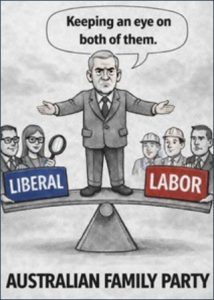
balance-cartoonIn South Australia, the Labor Government is spending somewhere in the vicinity of $50m on political advertising dressed up as ‘community information’.

Its 2022 election promise to ‘fix ambulance ramping’ has spectacularly failed – in fact, ambulance ramping is now twice as bad as it was in 2022.

And to buy off the Ambos – who were the most ardent campaigners for Labor at the last election – the government has just given them a massive pay rise.

The toxic algal bloom which has blighted the South Australian coastline for almost a year, has not been brought under control. And allegations that public servants have been told not to discuss the cause of the algal disaster until after the State election do not look good.

Labor’s green hydrogen debacle is projected to cost state taxpayers nearly $500 million while State debt is climbing towards $50bn, and South Australia, once considered the nation’s home-ownership capital, is now ranked the 2nd least affordable in Australia!

Labor has also introduced legislation into the South Australian parliament enshrining an Aboriginal Voice, despite the state voting overwhelmingly ‘No’ in the Voice referendum. Every electorate in South Australia voted ‘No’.

How’s does all that measure up against the governor–governed pact?

Who guards the guardians?

But what about the Liberals? Are they any better?

It was the actions of former Liberal Premier Steven Marshall and his Deputy Vickie Chapman, which took the Liberal Party into far-left areas normally the province of the Greens, that led to the establishment of the Australian Family Party in 2020.

Under the Liberals, the rights of faith-based organisations were threatened.

Led by Deputy-Premier Vickie Chapman, the SA Liberal Party proposed removing certain exemptions – the ‘Equal Opportunity (Religious Bodies) Amendment Bill 2020’ – which had allowed faith-based organisations to run their schools, hospitals and other services in accordance with their beliefs.

Liberal Treasurer Rob Lucas also attempted to deny a Christian college its payroll tax exemption. The college was forced to take the government to the SA Supreme Court to defend the matter.

And since the Marshall–Chapman government facilitated the passage of the Voluntary Assisted Dying Act, more than 500 South Australians have chosen to end their lives.

Conclusion

Pollsters and focus groups have reported that people don’t really trust the Liberals, but at the same time they can’t stand Labor and its hypocrisy – pushing its so-called ‘renewable’ energy schemes to save the planet one minute, and bulldozing thousands of trees to build golf courses and erect transmission lines the next.

Someone definitely needs to keep an eye on both of them …

Thank you for your support.

Filed Under: Australian Character, Australian Politics, Covid, Euthanasia, Family Policy, Freedom, Political language, Religious freedom, Renewable energy, Social policy, South Australia Election 2026, Voice to Parliament

Bounce Back Better

01/12/2025 by Australian Family Party

bounceIn a much-quoted exchange, a pollster once asked an Australian voter the following question: “Going into this election, and thinking about the average voter, what would you say is the biggest problem facing Australia today – ignorance or apathy?”
The voter replied, “I don’t know, and I don’t care”.

As we approach the South Australian State election, our key messages are crystal clear:

1. Competence & Care
Are you competent? And do you care?
Whether it’s your doctor, your mechanic or your child’s teacher, all you want to know about them is: ‘Are they competent?  And do they care?’
At the Australian Family Party, we stress the importance of appointing capable people.

2. Understanding the Times
In uncertain times, the choices we make shape our future.
At the Australian Family Party, we are focused on electing strong principled leaders — people who understand the times and know what needs to be done

3. Climate Change
If we wish to have a strong enough economy that can build a strong military to be able to defend ourselves against looming regional threats, then we are going to need to abandon our obsession with useless forms of energy generation, such as wind, solar and green hydrogen.
There is no climate emergency, there is no cause for panic.

4. Israel
In today’s uncertain world, the choices we make as a State and as a nation will determine our future. At the Australian Family Party, our support of Israel is what sets us apart.
Protecting our nation, strengthening our economy, and supporting our families is the foundation of a strong society. Australia – South Australia in particular, given its climate and topography – would benefit enormously from a closer relationship with Israel.

5. Let’s Make South Australia Great Again
Many South Australians can probably remember the time when more than a dozen of Australia’s top 100 listed companies had their head offices in Adelaide – News Ltd, Fauldings, Southcorp, Elders, Normandy Mining, Adelaide Bank, Adelaide Brighton, Standard Chartered Finance to name just a few. Today there’s just one – Santos (and even Santos is on borrowed time).

At the time of Federation, South Australia led the constitutional debates and had an influential hand in shaping the new Commonwealth of Australia.

For decades after, Adelaide was Australia’s Number 3 city – bigger and more prosperous than either Brisbane or Perth.

South Australia prospered when it supported people who made things, grew things, and built things.

Over recent years, some bad ideas have found their way into the South Australian Parliament resulting in some awful legislation being passed. These include: the ‘Urban Growth Boundary’ which gave us severe housing affordability problems; ‘Transforming Health’ which led to chronic hospital ramping; ‘Renewable Energy’ which resulted in SA having the most expensive power bills in the nation; ‘Anti-Life’ legislation that has given us those grotesque abortion-up-to-birth, assisted suicide and prostitution laws.

In addition, a conga-line of rent-seekers, bootleggers and carpetbaggers looking to exploit the public purse. These crony-capitalists, who base their business models on schmoozing politicians and convincing them that their particular goods or services are essential – and that the government should either pay for them or limit competition to providing them – have essentially created another layer of taxation.

This is important as South Australians already pay enormous amounts of tax in the form of GST, stamp duties, registrations, and numerous other levies and taxes hidden in water and power costs.

When state governments privatised SA’s water and power utilities, for example, they did deals with the purchasers permitting them to increase power and water charges in exchange for a higher purchase price of the utility – just taxation by another name. Consumers simply ended up paying more for their power and water. On top of that, utilities such as SA Water, then pay ‘dividends’ to the SA state government every year – ever more taxation under a different guise. SA Water has paid over $3bn in ‘dividends’ to the SA State Government over the past ten years. That $3bn should have been used to provide much-needed water infrastructure.

Yet in spite of all the revenue and dividends collected from SA taxpayers over the past ten years – up from $12bn in 2015 to $17bn in 2025 – the State Government’s reliance on subsidies from the other States to meet its spending commitments has also risen from $7bn in 2015 to $12bn in 2025, taking the SA State Government’s total spend from $19bn in 2015 to $29bn in 2025!

Why the other States continue to put up with South Australia’s flagrant spending habits is beyond me.

Likes and Dislikes

As you would have gathered, at the Australian Family Party:

We like …
South Australia, Australia, Farming, Mining, Small Business, Free Markets, Free Speech, Property Rights, Home Ownership, School Choice, Income Splitting, Traditional Family Values, Pro-life, Low Immigration, Australia’s Defence Forces, Israel.

And we dislike …
Big Government, Big Business, Big Unions, Rent Seekers, Wind Turbines, Solar Farms, Green Hydrogen, Net Zero, The Voice, Toxic Algae, Ambulance Ramping, Urban Growth Boundaries, $50bn State Govt Debt, Digital ID, High Immigration, High Crime Rates, Transgender Ideology, The UN, The WEF and The WHO.

bouncerStanding Guard
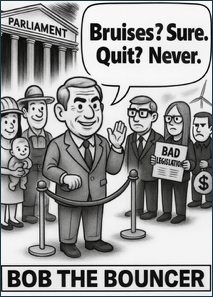
The key role of an independent or minor party member of parliament is that of a gatekeeper – ‘standing guard at the gate’ to prevent bad laws getting into the Parliament – someone who will ‘sound the alarm’ when dodgy legislation is presented to the parliament.

If Parliament House were a night club, they’d have a bouncer on the door only admitting those who would add value! Undesirables would be turned away.

As a former Senator, I know how to stand up to destructive policies and how to stop laws that drive up costs, disrupt society and make life harder for everyday Australians.

Walk …. Get Fit …. Go Letterboxing ….!

As we often say, it’s one thing to have an opinion – it’s a very different thing to support a cause.

With summer approaching, what better time to get fit, go for a walk …. and do some letterboxing!

Can you do some letterboxing in your area? As few or as many letterboxes as you like would be just fine.

Note: Political material is not junk mail. It is defined and protected by legislation as political communication.

If you would like to do some letterboxing, please let us know here (choosing ‘Admin’ as the recipient).

Thank you for your support.

Filed Under: South Australia Election 2026, Australia's economic future, Australian Character, Australian Politics, Climate Change, Defence, Family Policy, Family Resilience, Freedom, Housing Affordability, Israel, Renewable energy, Social policy, South Australia

Australian Idol

20/10/2025 by Australian Family Party

australian idolWhen John D. Rockefeller died in 1937, he was reputedly the richest man in the world.

At his funeral were many of his employees as well as a large contingent from the press.

Spotting Rockefeller’s chief accountant in the crowd, a young journalist from The Washington Post approached the accountant after the funeral.

“Weren’t you Mr Rockefeller’s accountant?” enquired the journalist.

“Yes, I was,” replied the accountant.

“Tell me,” whispered the journalist, “How much did he leave?”

“All of it,” whispered the accountant.

Rockefeller built Standard Oil, amassing (in today’s money) a $400bn fortune. He treated wealth as ‘life’s purpose’, crushing anyone who got in his way. In later life he admitted that his early greed was ‘demonic’.

Napoleon conquered all of Europe for political glory, crowning himself ‘Emperor of the French, King of Italy, Protector of the Rhine, King of Spain and King of Holland’.

For sporting glory, Lance Armstrong admitted to doping in seven consecutive Tour de France wins.

Examples of the pursuit of beauty and body-building image are too numerous to list.

Those who seek personal glory and those who seek financial opportunity are often frequent bedfellows. As are a good many cosy relationships between businesspeople and governments.

The French have a saying, ‘Plus ça change, plus c’est la même chose’ – the more things change, the more they remain the same.

The Bible, for example, recounts the incidence of a riot in Ephesus in 55AD.

The Apostle Paul had been preaching the gospel, and a number of people were converted to Christianity causing a drop in trade for the local idol-makers.

“About that time there arose a great disturbance … A silversmith named Demetrius, who made silver shrines of Artemis, brought in a lot of business for the craftsmen there. He called them together, along with the workers in related trades, and said: “You know, my friends, that we receive a good income from this business. And you see and hear how this fellow Paul has convinced and led astray large numbers of people here in Ephesus and in practically the whole province of Asia. He says that gods made by human hands are no gods at all. There is a danger that not only our trade will lose its good name, but also that the temple of the great goddess Artemis will be discredited; and the goddess herself, who is worshiped throughout the province of Asia and the world, will be robbed of her divine majesty.” (Acts 19:23–27)

Classic rent-seeking.

In recent times, Climate Change and its handmaiden Renewable Energy have become man-made idols and, like Rockefeller and Demitrius, anyone or anything standing in their way is crushed.

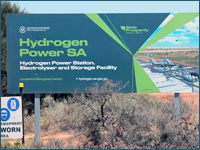
A good example of Renewable Energy being like ‘gods made by human hands which are no gods at all’, is so-called ‘green hydrogen’.

In 1975 – 50 years ago – during the 94th Congress, the US House of Representatives held the first of two investigative hearings on the subject of hydrogen – ‘its production, utilization, and potential effects on our energy economy of the future’.

The hearing was chaired by Congressman Mike McCormack, who claimed hydrogen ‘had the potential of playing the same kind of role in our energy system as electricity does today’.

In 2003 – 22 years ago – economist Jeremy Rifkin, published The Hydrogen Economy: The Creation of the Worldwide Energy Web and the Redistribution of Power on Earth.

In that book, Rifkin claimed that ‘Globalization represents the end stage of the fossil-fuel era. Turning toward hydrogen is a promissory note for a safer world’.

Then-President George W. Bush bought into the vision. In his 2003 State of the Union Address, he said, ‘With a new national commitment, our scientists and engineers will overcome the obstacles associated with taking hydrogen-fuelled automobiles from the laboratory to the showroom so that the first car driven by a child born today (2003) could be powered by hydrogen, and pollution-free’.

According to the US Bureau of Statistics, there were 4,089,000 children born in the United States in 2003.

Now aged 22, not one of them has bought a hydrogen-fuelled automobile.

A few months after his speech, the Bush Administration announced a collaborative effort with the European Union for ‘the development of a hydrogen economy’, including the technologies ‘needed for mass production of safe and affordable hydrogen-powered fuel cell vehicles’.

Hydrogen is indeed abundant, but it is not a source of energy. Like petrol or electricity, it must be manufactured. Which, in energy terms, is very expensive (it takes three units of electrical energy to produce two units of hydrogen energy). In other words, it requires a lot of electricity to make a small amount of hydrogen that is hard to handle, difficult to store, and expensive to use.

And yet, despite all that has been known for the past 30+ years, in 2019, South Australia’s politicians pumped hundreds of millions of dollars of taxpayers’ money into green hydrogen schemes.

In its Renewable Hydrogen Action Plan, the Office of Hydrogen Power announced ‘500,000 tonnes of green hydrogen would be produced annually by 2030’.

It has just been shut down.

If we want a strong enough economy that can build a strong military that can defend us against looming regional threats, then our politicians need to abandon their obsession with man-made idols such as climate change and renewable energy.

Swedish Statesman Axel Oxenstierna summed up the situation this way, “Behold my son, with how little wisdom the world is governed.”

That was 1640 – nearly 400 years ago.

Plus ça change …

Filed Under: Green hydrogen, Australia's economic future, Australian Politics, Climate Change, Defence, Family Policy, Net Zero, Renewable energy

Primary Sidebar

  • Facebook
  • Instagram
  • LinkedIn
  • Twitter

Bob Day AO, Federal Director Profile

Bob-Day-AO

Profile is here.

Subscribe to our Mailing list!

* indicates required


Recent Posts

  • The State vs the People
  • ‘Quis custodiet ipsos custodes?’
  • Which is Witch in ’26?
  • Christmas 2025
  • Never Again?
  • Bounce Back Better
  • The 44% Alarm Bell
  • Courtroom Guinea Pigs
  • Australian Idol
  • Shelter from the Storm
  • A Few Good Men
  • Standing on the Promises
  • The Promised Land
  • On Wings of Eagles

© 2026 The Australian Family Party
Privacy Policy
Contact Us