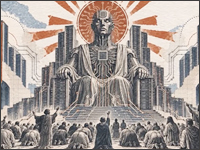
 In Part 1 we discussed the evolution of technology from the steam engine through to artificial intelligence and the creation of a digital god.
We closed Part 1 with St Peter’s renowned question, “Therefore, seeing that these things are going to happen, what manner of persons ought we to be?”
Often, a good starting point is to ask what we should not do! Or who we should not turn to.
Unequivocally, the answer to that question is politicians and public sector bureaucrats!
Artificial Intelligence is a veritable gift for politicians and bureaucrats who love nothing more than scaring people into giving them more power – Exhibit A: Covid. Exhibit B: Climate Emergency.
AI ups the ante – ‘It could kill us all in a decade!’
Fear is a powerful political motivator.
Niccolo Machiavelli, the Sixteenth-century archetype of the ruthless political operator, whose name became an adjective for cunning, deceit and the cold calculation of power, saw the political advantages in using fear to control the masses.
As journalist and author Nick Cater puts it, “Pick a threat, make it sound nasty then propose extraordinary government measures to fix it.”
Former Australian politician George Christensen puts it this way, “Never judge a government power according to the politician asking for it now; judge it according to the politician you fear may eventually inherit it.
“New powers should not be judged by the reassuring language wrapped around them, such as ‘protecting children’ or ‘keeping people safe’ or ‘threats to social cohesion’. They should be judged by what they actually allow the state to do and what could happen when those powers are eventually exercised by people who are far less restrained than their authors promised to be.”
In a similar vein, UK Bishop N.T. (Tom) Wright commented: “Do you know what the most frequent command in the Bible is? What instruction is given, again and again, by God, by angels, by Jesus, by prophets and by the apostles? Is it ‘be good’? Is it ‘be holy’? Is it ‘don’t sin’? No, the most frequent command in the Bible is, ‘Don’t be afraid’.”
Over recent years, we’ve seen political issues being increasingly described as ‘misinformation’, ‘disinformation’, ‘malinformation’, ‘extremism’, ‘dangerous’, ‘far-right’, ‘divisive’, ‘hate speech’, and ‘threats to social cohesion’.
Given them the power to control or regulate something as powerful as AI, and politicians and bureaucrats will, without doubt, use it to further their own ends, not yours or mine.
During Covid, former New Zealand Prime Minister, Jacinda Ardern gave us a glimpse of this with her declaration, “We will continue to be your single source of truth. Unless you hear it from us, it is not the truth”.
It is noteworthy that the loudest voices calling for more government oversight hail from the Left – the UK’s Jacob Coxon, the US’s Bernie Sanders, Australia’s David Shoebridge (Greens Party) and Anthony Albanese’s hand-picked member for Parramatta, Andrew Charlton.
“This is starting to look more and more like Marxism for the algorithmic age’, says technology entrepreneur Shyam Sankar.
In 2024, the Albanese Government attempted to introduce the ‘Combatting Misinformation and Disinformation Bill’, making its intentions very clear.
That same year, ‘misinformation and disinformation’ rose to number one on the list of the Top 10 risks cited by the World Economic Forum’s (WEF) Global Risks Report.
If and when the ‘Combatting Misinformation and Disinformation Bill’, is reintroduced and becomes law, all the government has to do is label something ‘misinformation’ or ‘disinformation’ or ‘malinformation’ to have it shut down.
Together with the Government’s latest proposal – the ‘Online Safety Act’ and its ‘Digital Duty of Care’ – the combination of these freedom-sapping pieces of legislation with more AI oversight, will become a mechanism for suppressing legitimate political speech and see personal freedoms deteriorate markedly.
To paraphrase Benjamin Franklin, ‘Those who surrender their freedoms for the promise of safety end up with neither’.
Finally, it was Adam Smith who first articulated the principle of ‘regulatory capture’, warning that merchants and manufacturers constantly attempt to manipulate laws and regulations to serve their own interests at the public’s expense. These days we call them ‘rent-seekers’.
The AI race is no different.
Dario Amodei heads up Anthropic, the current leader in AI development. Anthropic is a ‘closed’ AI model. Amodei is leading the call for government oversight.
‘Open’ AI models such as GPT, however, are not so keen on government intervention.
To summarize what our response to AI might look like:
- Stand fast; don’t be afraid.
- Treat everything politicians and bureaucrats tell you with the utmost scepticism.
- Be wary of industry players who call for more government intervention.
- Be wary of (don’t vote for), any politician asking for more power to control AI.
- Keep up to date with what is happening in the AI space.
- Limit your own digital footprint and the amount of data you share.
- Secure all your online accounts.
- Defend against AI-driven cyber-threats with strong credentials and unique passwords.
- As much as possible, be aware of everything that enters your home and family.
- Be more deeply present in your local church and community.
Thank you for your support.
 During a military training lecture, an Israeli General singled out a young soldier and asked him, ‘If you see 20 terrorists coming towards you, what would you do?’
 A political candidate was once asked where he stood on the issue of duck shooting.
 As the late Texas politician Robert Strauss used to say, “You can fool some of the people all of the time – and they’re the ones you need to concentrate on”.
 The story is told of the UN Secretary-General proposing that, in the interests of global peace and harmony, all the world’s soccer players should come together and form one ‘United Nations Global Soccer Team.’
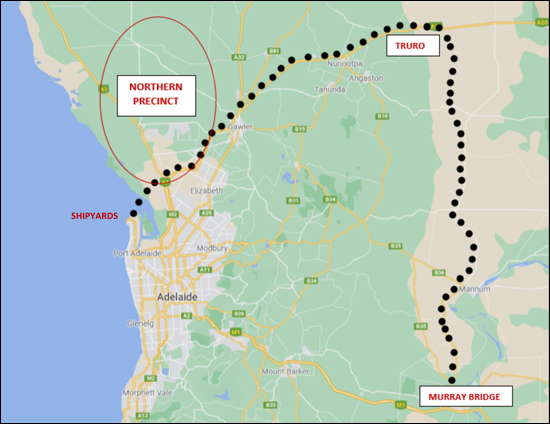
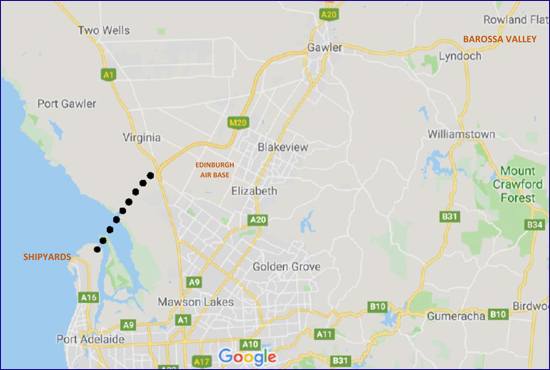
 Adelaide’s north can provide the land, and a new world-class gateway bridge over the Port River can connect the naval precinct with the northern Adelaide plains. Such a bridge and road system – perhaps even a rail line down the middle – would provide essential access to housing, supply chains and tourism opportunities – not to mention a ten-minute drive from the Edinburgh military air base.
 A fourth-year medical student had just finished top of his class at university.