 The Black by-election is over and, as widely reported, the seat switched quite spectacularly from the Liberal Party to Labor in a massive 13 per cent swing.
And while all the media attention was focused on the major parties, the Australian Family Party secured a very encouraging 5 per cent of the vote.
Our candidate, Jonathan Parkin, together with family, friends and Party members, worked tirelessly in the lead-up to the by-election and the results speak for themselves.
Replicated State-wide, 5 per cent would be more than enough to secure a SA Upper House seat and be well on the way towards a Senate seat.
As discussed previously, at the last Federal election, the total Centre-Right (CR) vote in each state (NSW 12.3%, Vic 11.5%, Qld 15.6%, WA 11.5%, SA 10.8%, Tas 9.8%) would have been enough to get a Senator elected in every state.
That equates to 12 Senators elected over the two-election Senate cycle, and yet only two out of six were elected – Queensland (One Nation) and Victoria (UAP).
If the CR minor parties (which, by and large, do genuinely believe in ‘family, faith and freedom’) are to counter the major parties, the Greens, left-of-centre minor parties and pseudo-independents, then they need to work more closely together.
This goes to the heart of what CR parties generally agree on – the primacy of the individual and the family over government. CR parties believe that governments are there to serve the people, not the other way around. They take the side of the people; the Left believes in the power of the state.
Accordingly, I am pleased to announce that the Australian Family Party is currently in merger talks with the DLP (formerly the Democratic Labor Party).
To be known as ‘DLP – Australia’s Family Party’, this new Party will add further potency and capability to our cause.
Having even one Upper House seat gives a party a platform, a status, and a portal into the Parliament for its members.
For any project to succeed it must work effectively on three levels – strategy, tactics and operations.
Strategy is the big picture. This is the primary aim. In our case it is to have twelve Senators who can hold together for a minimum of twelve years.
As with anyone who has ever done a jigsaw puzzle, it is vitally important to have the picture on the box before you start. In other words, what the puzzle will look like when it’s finished.
In our case, we want twelve Senators, representing our various political constituencies across six States to hold together to save the nation from people such as Jim Chalmers.
Tactics is about which Parties get to represent which States and at which election. Initially, agreement would be reached for both the 2025 and 2028 elections.
To have six Senators elected in 2025 and six more in 2028, it will be vital that all parties, in all six States agree to work together and for each other, keeping an eye on the main prize.
Operations are the day-to-day administration, compliance and member servicing. A modestly sized Secretariat would be able to manage this.
Shortly after World War II, George Orwell published his novel 1984.
The story was set in a country ruled by ‘Big Brother’, a supreme dictator in an all-powerful, one-party state. The central character, Winston Smith, whose job it was to re-write the nation’s history books to fit the current narrative of the state, was continually tormented by his task. The department in which he worked was called ‘The Ministry of Truth’.
Orwell’s novel exposed the true nature of authoritarian governments which hold on to power by generating fear, distorting facts and censoring alternative views.
For a book published in 1949, his description of surveillance technology to track and trace citizens is downright spooky.
“Know everything in order to control everyone”, said Adam Weishaupt.
Technology and mass surveillance allow governments to do just that – know everything.
More government, more spending, more taxes, more regulation, more state power, more state control. Income tax, payroll tax, land tax, petrol tax, the goods and services tax, stamp duty, excise duty on alcohol and tobacco, power company dividends, water company dividends, the River Murray Levy, the Emergency Services Levy, the Regional Landscape Levy, the Solid Waste Levy, the Medicare Levy, Council Rates and many, many more. Local, state and federal governments taxing us at every turn.
And of course, that most pernicious of all taxes – inflation tax.
Pernicious because it so disproportionally affects those who spend a higher percentage of their income on food, petrol, electricity and gas, which are more susceptible to price rises.
Naturally, the government blames everyone else for the price rises – greedy business owners, supply chains, Vladimir Putin … anyone but themselves.
In the story of the forest that was continually shrinking, the trees kept voting for the axe. The axe, you see, was very clever: it was able to convince the trees that because its handle was made of wood, it was one of them.
It will be our job to present an alternative to these axe-wielding, ‘top-down’ power merchants.
Thank you for your support.
 “Mine eyes have seen the glory of the coming of the Lord
 In the book of Revelation, the last book of the Bible, there is a vivid description of The New Jerusalem – The Holy City – referred to in John Bunyan’s Pilgrim’s Progress as ‘The Celestial City’, the ultimate heavenly home of believers.
 In William Jacob’s 1902 short story, The Monkey’s Paw, former Army officer Sgt Major Morris gives a mummified monkey’s paw he had brought back from India to his old friend Mr White.
 Former Greens Senator Lidia Thorpe, for example, was first out of the blocks wearing her green Hamas headband in solidarity. Likewise, Greens Senator Sarah Hanson-Young is happy to show her support for the Palestinian cause.
 John Lydon (aka Johnny Rotten of the Sex Pistols) is a clever guy.
 The story is told of a divine messenger who appeared to a peasant farmer.
 What you call something is very important.
 So said former New Zealand Prime Minister, Jacinda Ardern.
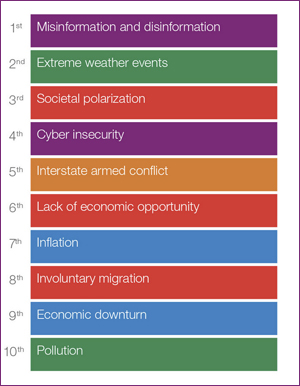 Internationally, ‘misinformation and disinformation’ have risen to number one on the list of top 10 risks cited by the World Economic Forum’s (WEF) Global Risks Report 2024.