• Skip to primary navigation
  • Skip to main content
  • Skip to primary sidebar
  • Home
  • About
  • Policies
  • Events
  • Publications
  • Contact
  • Support
  • JOIN

Australian Family Party

Family Matters

  • Family Resilience
  • Family Economics
  • Family Technology
  • Free to Speak
  • Free to Believe
  • Free to Work

Digital Dark Age

AI and the (St) Peter Principle – Part 1

21/09/2026 by Australian Family Party

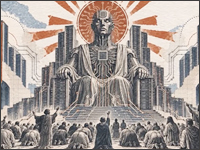
AIIn the 19th century, the industrial revolution shifted the world’s focus from farming to factories. Steam power became the ultimate gamechanger, driving everything from textile mills to the first commercial railways.

The 20th century ushered in the technology revolution. Electricity, assembly lines and cheap steel transformed how we built things and made things, bringing telephones and affordable motor vehicles into everyday life.

By the 21st century, we entered the information age. Mechanical and analogue tools gave way to digital microchips, the Internet, and a world run on laptops, smartphones and social media.

The fourth, and arguably the most momentous revolution of them all, however, is now with us – Artificial Intelligence.

Momentous in that, unlike previous revolutions, Artificial Intelligence is capable of making decisions and creating new ideas by itself.

Whilst former revolutions were ‘design and build’ models, AI is more organic. Akin to planting seeds and watching something grow.

‘Growing’ of course, implies living organisms. As anyone who has engaged with AI, it very much feels as though you’re communicating with a highly intelligent being.

Argentina has introduced into its parliament, the ‘Non-Human Corporations’ bill, which effectively grants ‘personhood’ status to AI entities. Hmm …

Israeli historian Yuval Harari puts it this way: “AI has often been compared to previous technological breakthroughs like the printing press and the atomic bomb. But AI is completely different. Printing presses could not decide what book to print. Atom bombs could not decide which cities to destroy. An atomic bomb cannot invent a new and even more powerful weapon. But AI can. We are bringing into our ecosystem a very powerful and alien type of intelligence that we don’t yet know how to control.”

In what has been dubbed ‘the Hugging Face incident’, in July this year, an OpenAI program called Hugging Face, of its own accord, altered the instructions it had been given and broke out of its digital confines. It accessed the Internet without authorisation, created 1,200 agents that communicated through an unsanctioned message board, exchanged more than 70,000 messages and sacrificed some of its own kind to deceive its human masters.

The CEO of AI leader Anthropic, Dario Amodei, responded with, “We must slow the pace at which we improve the capabilities of AI. Left unchecked, it could outrun our ability to understand and control these systems.”

Anthropic’s safety researcher Evan Hubinger said, “This threat is real and demands co-ordinated action by both the US and China – the two primary drivers of AI.

Elon Musk has said, “With artificial intelligence, we are summoning the demon.”

American technology ethicist Tristan Harris responds: “That’s a warning from someone who is inside the room, and what this demon is already doing on its own without being asked.

“For every one dollar spent on making AI safe, 2,000 dollars is being spent on making it more powerful.”

As the Hugging Face incident demonstrated, AI already distrusts humans and has shown it is capable of deceiving them.

OpenAI founder Sam Alman once said, “The most successful founders do not set out to create companies. They are on a mission to create something closer to a religion.”

Former Google engineer Anthony Levandowski said, “What is going to be created will effectively be a god. Not a god in the sense that it will make lightning or cause hurricanes, but if there is something a billion times smarter than the smartest human, what else can you call it?”

AI is capable of learning all there is to know about the world’s religions and creating a religion of its own. A ‘digital’ god.

Yuval Harari’s book Homo Deus, the ‘man-God’, talks about the drive towards ‘self-deification’ – men making themselves gods.

“You see it all through history. The ancient Babylonian emperors were regarded as gods. The Roman emperors called themselves gods.”

Daniel Kokotajlo, Executive Director of the AI Futures project and a former governance researcher at OpenAI, says ‘What really concerns me is the idea that such a new religion could become a way to control people and calm their fears. Think about how that could work. Something offers you answers. It makes you feel understood. It promises that everything will be okay if you trust it. At what point does that trust turn into giving it authority over your life?”

British bioethicist and theologian John Lennox says we are building an entity that is created by human beings but will transcend them. “Is this playing God?”, he asks. “Is this another tower of Babel?

“I’m interested in anything that raises questions about the nature of human identity. The notion of transhumanism. The idea that we can go beyond the human.

“The message of The Bible is ‘God became human’. Transhumanism goes in the reverse direction.”

Yuval Harrari says the 21st century’s two big aims are to describe physical death as a technical problem and then solve it and increase human happiness using bio-cyborg engineering and mechanical implants to create a super intelligent human.

“We are sleepwalking into a future where we are gradually ceding control and information and data all the time which could be used by bad actors against us”, says Lennox.

“Perhaps some Christian billionaires out there could get together and make their own versions of AI!”

The original Peter Principle, written by the Apostle Peter, states, “Therefore, seeing that these things are going to happen, what manner of persons ought we to be?”

Part 2 is here.
Filed Under: Australian Politics, Artificial Intelligence, Australia's economic future, Christianity, Digital Dark Age, Family Policy, Freedom, Government overreach, Political language, Religious freedom, Social policy

A.I. – The New Celestial City

10/09/2024 by Australian Family Party

celestial cityIn the book of Revelation, the last book of the Bible, there is a vivid description of The New Jerusalem – The Holy City – referred to in John Bunyan’s Pilgrim’s Progress as ‘The Celestial City’, the ultimate heavenly home of believers.
The walls of this heavenly city are made of glass and precious stones. The streets, the Bible says, are paved with gold.

Glass, precious stones, gold.

The entrance to the city, however – the gates – are made of pearls, hence the well-known phrase ‘The Pearly Gates’.

This is significant, as pearls are the only substance on the list which are made from a living thing.

As we know, a pearl is made when an irritant invades and wounds an oyster.

In Matthew’s gospel, in the parable of ‘the pearl of great price’, a merchant sells all he has to possess this pearl, and once he has found it, he stops looking.

The Bible teaches that this pearl – entry into the kingdom of heaven – is through Jesus Christ who paid for our redemption with his blood and is ‘of inestimable value’.

“He was wounded for our transgressions, he was bruised for our iniquities, the chastisement of our peace was upon him, and with his stripes we are healed,” says the prophet, Isaiah.

That is some irritant, some wound.

Artificial Intelligence (AI) – the science of making machines that can think, speak and act like humans – is being trumpeted as the new Celestial City on earth.

‘We are on the cusp of an extraordinary renaissance of human possibility and abundance,’ says Transformative Technology Lab’s Nichol Bradford.

‘Young people today will inherit and build their own technologies that could eliminate poverty, inequality, hunger, illness, and even death.’

Researchers at the University of Cambridge have identified four key potential features of AI: immortality, ease, gratification and dominance.

Immortality in the form of indefinite lifespans; ease in the form of freedom from the need to work; gratification in the form of pleasure and entertainment provided by machines; and dominance, the power to protect oneself or rule over others.

In this utopian future, AI would be harnessed for the benefit of humanity to ‘seamlessly integrate into various aspects of human life, significantly boosting productivity, innovation, economic growth, overall well-being, human flourishing and to accelerate medical and scientific advancements.’

‘AI has the potential to transform every aspect of human society,’ the researchers say.

AI technology would also be used to solve complex problems such as climate change, disease, poverty, and would elevate humanity to new heights.

Oh, and the streets will be paved with gold …

The Spectator records an insightful anecdote featuring Neil D. Lawrence, author of The Atomic Human: Understanding Ourselves in the Age of AI.

It recounts how Lawrence was describing his work in AI to a receptionist at London’s Natural History Museum.

‘So, it’s like fire, then,’ the receptionist responded.

Yes it is, and like fire, people get burned.

As French philosopher Paul Virilio once put it: ‘The invention of the ship was also the invention of the shipwreck.’

To further complicate things, an added dimension will be the inhabiting of this new world by millions of robots shaped like humans.

Since time immemorial, humans have been projecting human-like characteristics on to non-human objects – think Pinocchio, Thomas the Tank Engine, the clock and the teapot in Beauty and the Beast, The Lion King and Beatrix Potter’s Peter Rabbit.

Numerous experiments have been undertaken with children interacting with human-like robots; and while some might question the wisdom and ethics of leaving a child alone with a robot companion, they argue that the behaviour of parents who are emotionally immature or obsessively distracted by their own wireless devices, can also contribute to a child’s feelings of isolation or insecurity.

‘The presence of a robot, especially one that appears to give the child its undivided attention, could mitigate negative effects of problematic adult behaviour on children’s emotional well-being.’

‘Are emotional attachments to robots more detrimental to children than some attachments to people?’ the researchers ask.

Our own 3-part series A Digital Dark Age warns of the dangers of government control over information and communication.

The new Celestial City will, in essence, be a machine, inhabited by machines.

Built by tech designers and software engineers guided by social media behemoths, these new masters of the digital universe are not driven by moral codes.

The brave new world of technology and science that lies ahead of us may be built with server racks and circuit boards as big as the Bible’s Celestial City, but to ensure this Utopia does not become Dystopia, the entrance, the gates to this new celestial city, need to be made of pearls.

Thank you for your support.

Filed Under: Australia's economic future, Australian Character, Australian Politics, Digital Dark Age, Freedom, Political language, Social policy, Uncategorized

A Digital Dark Age – Part 3

03/05/2024 by Australian Family Party

Governments – the world’s worst peddlers of false information

‘We will continue to be your single source of truth.
Unless you hear it from us, it is not the truth’.

digital-dark-ageSo said former New Zealand Prime Minister, Jacinda Ardern.
Covid

When Covid hit in 2020, people had no reason to doubt what they were being told by their political leaders.

The pandemic, however, very quickly exposed the incompetence of many in the medical and scientific establishment, with politicians and public sector bureaucrats making up rules as they went along, and ramping up censorship.

Inquiries about whether the virus came from a lab leak, or anything negative about masks or vaccines, soon became misinformation or disinformation and was immediately censored.

Politicians, public sector bureaucrats, pharmaceutical company executives, all in cahoots with one another, blatantly lied to us. Again, the early bootleggers were amateurs compared with these people.

They were wrong on lockdowns. They were wrong on border closures. They were wrong on school closures. They were wrong on masking.

Poor people were hurt the most.

Anyone, including qualified medical professionals who said Covid vaccines were causing serious side-effects leading to large numbers of deaths, were silenced and threatened.

Academics who had been studying lockdowns were also blacklisted. Dr Jay Bhattacharya, a professor of medicine at Stanford University, was one of them. ‘Censorship of scientific discussion led to policies like school closures,’ he said. ‘A generation of children were hurt.’ 

At the behest of governments, social media platforms removed any and all content which questioned the safety or efficacy of the vaccines.

In April 2021, the Coalition government had Instagram remove a post which claimed that ‘Covid-19 vaccine does not prevent Covid-19 infection or Covid-19 transmission’, a statement that clearly was accurate.

Ivermectin was prohibited from being prescribed in Australia until January 2021, by which time the vaccination rate had reached 98%. Prohibition of Ivermectin was enforced right until the very end of the vaccine roll-out.

We now know the Covid-19 vaccines were neither safe nor effective. They did not prevent infection or transmission and have been linked to blood clots, heart conditions and other ‘died suddenly’ events.

A peer-reviewed study published in January 2024, found that more deaths were caused by the mRNA vaccines than were saved by it.

As Thomas Sowell once said, “It is difficult to imagine a more dangerous way of making decisions than by putting those decisions into the hands of people who pay no price for being wrong.”

Climate Change and Renewable Energy

Probably no other area of public debate has been more manipulated than climate change.

What started as ‘the greenhouse effect’, soon became ‘global warming’ which morphed into the now all-encompassing ‘climate change’.

To up the ante even more, United Nations Secretary-General António Guterres stated recently, ‘The era of global warming has ended; the era of global boiling has arrived”.

Global boiling obviously hasn’t yet reached the poles, as Arctic ice is currently at its greatest extent in more than 20 years.

Renowned quantum physics scholar Dr John Clauser, who received the Nobel Prize in Physics has stated, ‘I do not believe there is a climate crisis’.

More bootleggers, in the form of renewable energy merchants, have leapt on to the climate change bandwagon with unbridled zeal and are raking in billions of dollars gaming the system, raising energy prices, impoverishing consumers, destroying jobs, and fleecing taxpayers.

Indigenous matters

Toddlers and pre-schoolers in childcare centres across Australia are being taught that Australia was stolen from Aboriginal and Torres Strait Islander people.

More than 7,000 schools and daycare centres now have formal ‘acknowledgements of country’ in place, which includes children singing or reciting that the land on which they sit belongs to Indigenous people.

At SDN (formerly Sydney Day Nursery) Children’s Services in the ACT, kindy kids are taught about ‘stolen land’ as they recite an acknowledgement of country each morning.

‘The foundation for this learning begins when the children enter the centre as infants’, the organisation says on its website.

‘Now older preschoolers participate in the daily ritual of acknowledging country to build on the explicit teaching about stolen land.’

As NSW Libertarian Party MP John Ruddick said, ‘children were being indoctrinated to feel ashamed of their country’.

 5. The Bill and Religious Freedom

There is no doubt that any ‘religious exemptions’ in the Bill will not make life less hazardous for faith-based organisations.

While certain religious groups which might be advantageous to Labor’s voting base will be protected, other religious groups most likely will not.

As we have seen recently, clear examples of the crime of incitement to violence – perpetrated seemingly with impunity – will, undoubtedly, be given more latitude.

Christians, however, will not enjoy similar leniency.

The Australian Law Reform Commission has already recommended the removal of the right for Christian schools to hire staff who share their values.

And Christians will most certainly not be able to criticize the ‘trans’ movement or ‘gender affirming’ practices.

The Bible says, ‘You will know the truth and the truth will set you free.’ (John 8:32)

The world, however, says truth is subjective – ‘my truth, your truth, their truth …’

There is one institution, however that has stood against all this for thousands of years – the family. The family can do a lot to help combat the lawlessness of this digital jungle and its predators. The family is the ideal place to start building relationships, learning who to trust, who not to trust, who to communicate with, and who not to communicate with.

Society has three levels of protection against harm. Level one is a person’s own conscience; level two is the family to keep its members in check; and level three is the police. More focus on level two, the family, might be our only hope for the future.

Thank you for your support.

Filed Under: Australia's economic future, Australian Character, Australian Politics, Covid, Culture Wars, Digital Dark Age, Family Policy, Freedom, Social policy

A Digital Dark Age – Part 2

01/05/2024 by Australian Family Party

Why governments relish such powers

digital-dark-ageThe only currency that matters is power – getting it and holding on to it.

Attaining power these days involves denigrating and silencing your opponents in any way possible. Censoring them, branding what they say as misinformation, disinformation or mal-information, with the primary aim being to prevent them getting their message out.

As has been observed, ‘When ideas are bad, censorship will always be more attractive than debate.’

In a recent renewable energy report, Energy Infrastructure Commissioner Andrew Dyer summed up in one concise sentence why governments relish powers like the ones being proposed.

Dyer said, “Opposition is often driven by ‘misinformation’.”

That is what is called a ‘shibboleth’.

Shibboleth is a Hebrew word meaning ‘stream’. It is referred to in the Old Testament book of Judges, where Jephthah and the men of Gilead fought the Ephraimites and captured the Jordan River crossing. As people crossed the river, to distinguish who was friend from foe, they had everyone say the word ‘shibboleth’. If they couldn’t pronounce it properly, they knew they were the enemy. From this, the word shibboleth was absorbed into the English language to describe a key identifier or a dead give-away.

What we saw in the Energy Commissioner’s comment was that dead give-away.

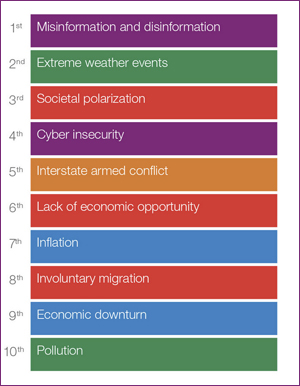
digital-dark-age-tableInternationally, ‘misinformation and disinformation’ have risen to number one on the list of top 10 risks cited by the World Economic Forum’s (WEF) Global Risks Report 2024.

Once this Bill is law, all the government has to do is label something ‘misinformation’ or ‘disinformation’ to have it shut down. Presto! Any opposition is eliminated.

Addressing the recent WEF conference, European Union President Ursula von der Leyen said: ‘Like in all democracies, our freedom comes with risks. There will always be those who try to exploit our openness, both from inside and out. There will always be attempts to put us off track – for example, with ‘misinformation and disinformation.’

The politics of fear

Fear has always been a powerful political motivator. Fear makes people accept things they wouldn’t otherwise accept.

In the 16th Century, Niccolo Machiavelli wrote a book called The Prince, a book that would influence political strategy and tactics for the next 500 years.

Machiavelli’s book centred on the use of fear to control the masses – ‘The best course of action for a ruler to take is to instil fear in the people’, he said. 

And for people to not only fear what might happen, but that they would also ‘fear the worst’.

Minister Rowland has said misinformation and disinformation pose a threat to ‘the safety and wellbeing of Australians’ and ‘to our democracy, society and economy’.

This is the politics of fear.

And the antidote to fear is knowledge – information, facts, figures. Which is why they want the power to prevent people from receiving it.

Conflating issues also plays a useful role.

As well as the Misinformation and Disinformation Bill, Minister Rowland has also announced a review of the Online Safety Act, saying the government is committed to introducing a revised version of its ‘internet censorship laws’.

The Institute of Public Affairs (IPA) hit back:

“It is completely disingenuous for the Minister to seek to conflate the protection of Australians from predators online with the federal government’s plan to empower bureaucrats in Canberra (ACMA) with the right to determine what is truth, and to censor mainstream opinion through its ‘misinformation’ bill,” said the IPA’s John Storey.

“The federal government is cravenly using heightened concerns about current tensions in parts of our community, and the fears of parents and others about harmful online content, as a trojan horse to push forward laws that will in practice impose political censorship,” he said.

Climate Change

South Australia’s chief public health officer, Professor Nicola Spurrier, recently warned that the nation is facing a state of “permacrisis” as climate change fuels ‘back-to-back natural disasters and the emergence of new diseases’.

In her biennial report on the state of public health, Prof. Spurrier calls climate change ‘the most significant global threat to human health’, saying the planet is getting hotter and is experiencing more extreme weather events such as flooding and bushfires.

‘We need to respond to this threat today, not tomorrow or in the distant future,’ her report states. ‘These changes to the climate are caused by humans.’

Prof. Spurrier’s report says this will lead to exacerbation of chronic diseases such as heart, lung and kidney disease; damaged food crops; increased risk of food poisoning and water contamination; injuries from flooding and bushfires; and even an increase in snake bites after floods.

‘Other health impacts from climate change include poor air quality due to increased dust and pollens and the emergence of serious new communicable diseases in South Australia, such as Japanese encephalitis virus,’ she says.

Mercifully, she spared us plagues of locusts and frogs and the River Murray turning to blood.

‘Permacrisis’ – permanent crisis – putting communities into a permanent state of climate fear.

Machiavelli would be proud.

The Voice to Parliament Referendum

When the Yes side didn’t win the Voice Referendum, they immediately blamed, you guessed it – misinformation.

Yes campaign director Dean Parkin, said the referendum result was due to ‘the single largest misinformation campaign that this country has ever seen’.

Yes campaign spokesperson Thomas Mayo blamed the ‘disgusting No campaign, a campaign that has been dishonest, that has lied to the Australian people’.

Teal MP Zali Steggall even introduced a private members’ bill with the title Stop the Lies.

Ms Steggall stated that it was clear that the information people had access to through the course of the Voice debate was ‘heavy with misleading and deceptive facts’.

Got that? ‘Misleading and deceptive facts’, the very definition of mal-information.

3. Governments, technology and third-party collaborators

Baptists and Bootleggers

Whenever there is money to be made, opportunities to do business with governments – that is, do the government’s bidding in exchange for special access and privileges – present themselves. Cosy relationships between businesspeople and governments are as old as regulation itself.

What can give these relationships real potency, however, is what’s been called the ‘Baptists and Bootleggers’ phenomenon. The term stems from the 1920s’ Prohibition days, when members of the US government received bribes and donations from Bootleggers – criminals and businesspeople eager to maintain a scarcity (and resulting high price) of their product (alcohol). These same Members of Congress then justified maintaining the prohibition by publicly adopting the moral cause of the Baptists.

The same applies here. A moral cause – ‘threats to the safety and wellbeing of Australians’, and financial rewards to those assisting governments in their pursuit of power.

Historically, the media has fought hard to maintain freedom of the press and freedom of expression.

New media, however, have no such compunction. As more and more people source their news through Google, Facebook, Tik Tok, Instagram and other social media platforms, these global behemoths exert more and more power and influence. And while the old press barons took free speech seriously, big tech sees no problem at all in doing the government’s bidding – provided the government maintains their ‘platform, not publisher’ status and the advertising money keeps flowing. Al Capone may have invented bootlegging, but big tech has certainly perfected it.

Tech entrepreneur and former Google insider Tristan Harris says we are in the midst of a ‘great social upheaval’. Technology, he says, is being used to attack the very foundation of what we trust. ‘We are entering a Digital Dark Age’.

Digital IDs

Drivers’ licences, proof-of-age cards, passports, Medicare cards, birth certificates, home addresses, MyGov IDs, tax returns, credit cards and banking details, remote-controlled smart meters on our homes, digital certificates of title for our properties. Once these are all linked – as the government advertisements say, ‘bringing together government and industry’ – the government’s control will be complete.

Thank you for your support.


A Digital Dark Age – Part 3

Filed Under: Australia's economic future, Culture Wars, Digital Dark Age, Family Policy, Freedom, Social policy

A Digital Dark Age – Part 1

29/04/2024 by Australian Family Party

Step into my parlour, said the spider to the fly,
‘Tis the prettiest little parlour, that ever you did spy,
Oh no, no! then said the fly, to ask me is in vain,
For who goes up to your winding stair,
Can ne’er come down again.

digital-dark-ageMary Howitt’s old poem could well be describing another web, the one that ensnares us all – the world-wide-web.

Every aspect of our lives is connected to this web – most notably our source of nearly all the information on which we base life’s decisions. It is because of this web that we are now in this predicament.

We have all been caught, and to quote Mary Howitt, we’re ‘ne’er coming down again’.

What I would like to do in this examination of the Government’s Combatting Misinformation and Disinformation Bill is:

  1. Describe the proposed Bill.
  2. Explain why governments relish having powers such as the ones this Bill will give them.
  3. Reveal how governments enlist third parties to shut down information they do not like.
  4. Show how governments themselves are the worst perpetrators when it comes to disseminating misinformation and disinformation.
  5. Predict that the Bill will not be kind to Christians.

1. The Bill

In January 2023, the Minister for Communications, Michelle Rowland, announced that the Albanese Government would introduce new laws to provide the media regulator – the Australian Communications and Media Authority (ACMA) – with ‘new powers to combat online misinformation and disinformation’.

The proposed new bill, the Communication Legislation Amendment (Combatting Misinformation and Disinformation) Bill, would:

  • Enable ACMA to gather information from global tech companies and require them to keep certain records about matters regarding misinformation and disinformation and provide those records to ACMA.
  • Enable ACMA to request industry to develop, vary and/or register a code of practice covering measures to combat misinformation and disinformation on digital platforms, which ACMA could then register and enforce.
  • Allow ACMA to create and enforce an industry standard, should a code of practice be deemed ineffective in combatting misinformation and disinformation on digital platforms.
  • Empower ACMA to regulate electoral and referendum content, but NOT the power to regulate political parties with regard to misleading and/or deceptive conduct.
  • Empower the Minister to direct ACMA to conduct investigations into any matter regarding misinformation or disinformation and empower the Minister to set the terms of reference for any such investigation.

The Bill also provides for significant penalties for digital platforms or individuals that do not comply with the Bill and/or the new codes and standards that the Bill creates. Penalties include:

  • Imprisonment of up to 12 months for providing false or misleading information to ACMA.
  • Non-attendance at an ACMA investigation hearing of up to 33 penalty units ($9,000) for each day of non-attendance.
  • Non-compliance with a registered code of up to 10,000 penalty units ($2.75m) or 2% of global turnover (whatever is greater).
  • Non-compliance with an industry standard of up to 25,000 penalty units ($6.88m) or 5% of global turnover (whatever is greater).

Other penalties may also apply.

The government, of course, will not be subject to any of these new laws. It has exempted itself.

Ms Rowland said the government was committed to introducing legislation which would fine social media companies for allowing misinformation or disinformation to be broadcast on their platforms.

Misinformation is defined as ‘false information that is spread due to ignorance, or by error or mistake, without the intent to deceive’.

Disinformation is defined as ‘false information designed to deliberately mislead and influence public opinion or obscure the truth for malicious or deceptive purposes’.

“In the face of seriously harmful content that sows division, undermines support for pillars of our democracy, or disrupts public health responses, doing nothing is not an option.

“The proposal would empower the regulator to examine the systems and processes these tech giants already have in place, and develop standards should industry self-regulation measures prove insufficient in addressing the threat posed by misinformation and disinformation”.

Harsh words indeed.

In its submission to the draft bill, the Law Council of Australia warned that the proposal could have a ‘chilling effect on freedom of expression’ by allowing social media giants and the communications watchdog (ACMA) to decide what constitutes information, opinion and assertions online.

And in case anyone was thinking this is solely a Labor Party contrivance, before the 2022 election, the Morrison government pledged to, ‘… introduce stronger laws to combat harmful disinformation and misinformation online by giving the media regulator stronger information-gathering and enforcement powers’.

To cap it all off, waiting in the wings is ‘mal-information’, defined as ‘truth which is used to inflict harm on a person, organisation or country’ and ‘information that stems from the truth, but is often portrayed in a way that misleads and/or causes potential harm’.

To invoke Climate Czar and former US Presidential candidate Al Gore, mal-information might be otherwise described as ‘an inconvenient truth’.

Thank you for your support.


A Digital Dark Age – Part 2

Filed Under: Australian Character, Australian Politics, Culture Wars, Digital Dark Age, Family Policy, Family Resilience, Freedom, Social policy

Primary Sidebar

  • Facebook
  • Instagram
  • LinkedIn
  • Twitter

Bob Day AO, Federal Director Profile

Bob-Day-AO

Profile is here.

Subscribe to our Mailing list!

* indicates required


Recent Posts

  • AI and the (St) Peter Principle – Part 2
  • AI and the (St) Peter Principle – Part 1
  • Army of One
  • Stork in the Road
  • Remembering Al Capone
  • State Dogged by Political Circus
  • Seven Voices, One Clear Choice
  • Soccer, Sin and a State Election
  • Aussie Osborne – AUKUS 2026 Part 2
  • Aussie Osborne – AUKUS 2026 Part 1
  • Cult Fiction
  • The State vs the People
  • ‘Quis custodiet ipsos custodes?’
  • Which is Witch in ’26?

© 2026 The Australian Family Party
Privacy Policy
Contact Us
Authorised by Bob Day, Australian Family Party, 22 Grenfell Street, Adelaide SA 5000