• Skip to primary navigation
  • Skip to main content
  • Skip to primary sidebar
  • Home
  • About
  • Policies
  • Events
  • Publications
  • Contact
  • Support
  • JOIN

Australian Family Party

Family Matters

  • Family Resilience
  • Family Economics
  • Family Technology
  • Free to Speak
  • Free to Believe
  • Free to Work

Family Policy

Camels on the Horizon

05/04/2024 by Australian Family Party

camelsThe story is told of the founder of Dubai, Sheikh Rashid, who, when asked about the future of his country replied:

“My grandfather rode a camel. My father rode a camel. I drive a Mercedes. My son drives a Land Rover, and my grandson will drive a Land Rover.”

“But my great-grandson will ride a camel.”

“Why would that be?”, he was asked.

He replied, “Hard times create strong men, strong men create easy times, easy times create weak men, weak men create difficult times.”

Many great empires have risen and fallen within relatively brief periods of time – Persian, Trojan, Egyptian, Greek, Roman, Ottoman, British – all have come and gone.

Most were not conquered by external enemies but rotted from within.

Members of what has been called ‘The Greatest Generation’ – those born between 1900 and 1930 – fought and won two World Wars, survived the Great Depression and defeated communism. They also created the most prosperous era (1950–1990) the world had ever known.

Strength gave rise to prosperity. With prosperity came easy times.

We know what came next because we are now living in those difficult times.

The foundation of all prosperity is energy, and it will be the destruction of our energy system in pursuit of so-called renewables that will result in our great-grandchildren riding camels.

But there is still time to change course.

It’s been said, ‘there are no bad soldiers, only bad generals’.

Or, ‘better a mob of sheep led by a lion, than a mob of lions led by a sheep’.

It has not gone unnoticed that the last few referendums – or referenda to be more precise – haven’t gone the way they were supposed to go. The Voice here in Australia, the Irish referendum on the role of women in the home and the makeup of the family, and of course Brexit, all went against what the prevailing government of the day wanted.

As we know, it was once the case that the people would demand that their governments pass new laws to fix some social ill.

These days, it is the government that demands that the people pass new laws, via referendum, to further the government’s agenda.

This does not bode well for the future of referendums.

As German playwright Bertolt Brecht once said, ‘Some party hack has decreed that the people had lost the government’s confidence. If that is the case, would it not be simpler if the government simply dissolved the people and elected another people?’

Don’t give them any ideas.

As the Irish referendum demonstrated, people are not yet ready to give up on the principle that the nuclear family – mum, dad and the kids – is the basic unit of society and the foundation of freedom.

As journalist Virginia Tapscott says, “The chasm between what the top end of town thought was good for women and what grassroots women actually want was wider than anyone could have predicted.”

It is why we at the Australian Family Party believe the family should be the state’s top priority, particularly when it comes to concerns over social media.

Interviewed by The Weekend Australian Magazine, American social psychologist Jonathan Haidt, Professor of Ethical Leadership at the New York University Stern School of Business, says of the experiment with the smartphone:

“There’s never been anything this big that we’ve done to children. It is affecting the majority of children, not just in the United States, but in all the English-speaking countries and in Scandinavia. And while I cannot say that growing up on a smartphone is as bad as being lead ­poisoned or sent to work in a factory when you’re young, what I can say is that as a choice we made about how to raise our children thinking it was OK, this is the biggest blunder we have ever made.”

As this website has said many times, the family is the best place to build relationships and learn who to trust, who not to trust, who to communicate with, and who not to communicate with.

Let’s face it (pun intended), Facebook friends are not real friends, they are not family. Real family is mothers, fathers, brothers, sisters, grandparents, aunts, uncles and cousins.

The family is the one institution which can combat the lawlessness of the digital jungle and its predators. It is more powerful than the tech titans and the cyber-bullies and their algorithms.

It is time to strengthen the family – before those camels arrive.

Endnote 1: Dunstan by-election

At the South Australian State election held two years ago, Liberal Premier Steven Marshall defeated the Labor candidate Cressida O’Hanlon by just 260 votes.

At the recent by-election caused by the resignation of Steven Marshall, the same Labor candidate defeated the Liberal candidate Anna Finizio by 360 votes.

For a sitting Premier to garner just a handful more votes than a newbie candidate (out of more than 20,000 votes) says something.

There was essentially no difference between Labor’s result and the Liberals’ result between 2022 and 2024. Each dropped 3% to the Greens who increased their vote by 6% – from 13% to 19%.

Our candidate, Nicole Hussey, received 440 primary votes (2.0%).

The Australian Family Party’s primary aim in contesting the by-election and preferencing the Liberal candidate was to support Opposition Leader David Speirs for his commitment to traditional values of family, faith and freedom.

As we are fond of saying, ‘every bit helps’, hence our encouragement to others of like-mind to support an Opposition Leader of like-mind following four years of decidedly anti-family, faith and freedom rule.

A big thank you also goes out to all our volunteers who worked the early voting centre and on election day.

Endnote 2: Church & State Conference

For those who can’t get enough of this stuff, don’t forget to register for Dave Pellowe’s Church & State Conference in Hobart/Launceston/Perth/Adelaide. Register here.

Thank you for your support.

Filed Under: Australia's economic future, Australian Character, Australian Politics, Culture Wars, Election 2024, Family Policy, Freedom, Social policy, South Australia, Voice to Parliament

The Winning Circle

06/03/2024 by Australian Family Party

holmesIn ‘The Adventure of Silver Blaze’, one of the Sherlock Holmes short stories, Holmes is sent to investigate the disappearance – on the eve of an important race – of a champion racehorse called Silver Blaze, and the death of its trainer John Straker.
In what has become a famous exchange known as ‘the curious incident of the dog in the night-time’ between Scotland Yard’s Inspector Gregory and Sherlock Holmes, Gregory asks Holmes, ‘Is there any other point to which you would wish to draw my attention?’

‘Yes’, Holmes replied, ‘To the curious incident of the dog in the night-time’.

‘But the dog did nothing in the night-time’, said Gregory.

‘That was the curious incident’, Holmes replied.

That the dog didn’t bark told Holmes the person who took the racehorse was known to the dog. The thief was not a stranger. It was an inside job.

This exchange has become symbolic of the need to speak up or ‘bark’ when something is amiss.

Rest assured, here at the Australian Family Party we will not hesitate to bark.

There is no doubt South Australia has economic and social problems that it is going to have to solve – high mortgages (forcing both parents out to work), high cost of living (educating and raising children, power prices, water prices), health (bulk billing, ambulance ramping) – and social ills caused by the rupturing of family relationships.

Our State also has economic and social goals it wants to achieve.

But all we seem to get are endless announcements and pronouncements – ninety per cent of which is all BS according to our Premier – about ship building, green hydrogen, 24/7 pharmacies, upgrading Main South Road and all manner of other government grants and subsidies.

The Australian Family Party believes it is the family that should be the State’s top priority.

We believe it is time to strengthen the family, to protect the family, to fight for the family.

Let’s face it, your family is the only thing you’d take a bullet for.

Family provides meaning, belonging and security. Strong family relationships reduce depression and anxiety disorders, strengthen the immune system and speed recovery from surgery.

We all know there is no model or perfect family – every family is flawed in some way because it is made up of flawed human beings. But the family is the place to cultivate the right way to view life and the world around us. These are indeed difficult times, but we’ve known hardships before. They are the snakes and ladders of life and these too will pass.

Social ills caused by the rupturing of family relationships – divorce, de-facto relationships, fatherless households, single mothers bringing up children, high housing costs – lead to a breakdown in society.

Family breakdown is costly. Mental illness costs the economy $200bn a year. More than 3,000 Australians take their lives each year. More young men take their own lives than are killed in road accidents. Boys raised in father-absent environments are five times more likely to commit suicide, ten times more likely to abuse drugs, fourteen times more likely to commit rape, and twenty times more likely to end up in a correctional facility. Fatherless households are a dreadful problem.

As are divorce, domestic violence, loneliness and addiction to alcohol, gambling, drugs and pornography.

Suicide rates are on the rise. Rates of depression have sky-rocketed. Drug overdoses, the ICE scourge – something is very wrong.

As The Australian’s Paul Kelly has said, ‘An alarming number of people are damaged, lonely or depressed. This is the road Australia is travelling.’

The Australian Family Party believes we can serve Australia best by putting the family first.

We can build up society by building up the family. Faith and family, a sublime combination.

Which brings us to the South Australian by-election for the seat of Dunstan, caused by the retirement of former Liberal Premier Steven Marshall.

Matthew Abraham, who has been covering SA politics for a very long time, said before the last State election that he could see no ideological differences between Liberal and Labor.

“Steven Marshall is now essentially a Labor premier”, he said.

In 2017, Christopher Pyne, then leader of the Liberal Party’s left-leaning, progressive faction and mentor to Steven Marshall, said the Liberal progressives were winning the internal battle against the Party’s conservatives. “We’re in the winning circle”, he said.

How well did that work out for them?

Well, both men are now gone, the Liberal Party having lost both State and Federal elections in 2022.

In South Australia, the Liberals have now elected a more conservative leader in David Speirs to help them return to the real winning circle.

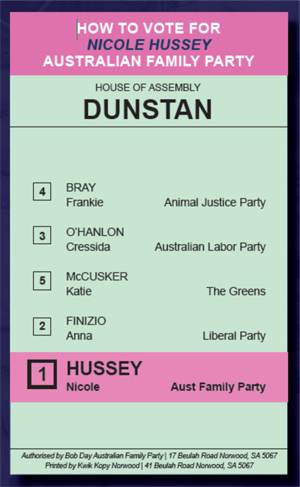
As a token of support – the Australian Family Party believes David Speirs has earned the right to lead his party to the next general election – we will be preferencing the Liberal Party – see How-to-Vote card (right).

The Australian Family Party’s candidate in Dunstan is Dr Nicole Hussey. A former research scientist who now teaches biology and chemistry, Nicole has had a wide experience in the medical/scientific sector and has direct knowledge of our education system.

The by-election is on Saturday 23 March, with early voting from 12 March – 22 March.

If you would like to help Nicole, please let us know here (choose Federal Director from the button list).

Thank you for your support.

Filed Under: Australia's economic future, Australian Character, Australian Politics, Election 2024, Family Policy, Family Resilience, Social policy, South Australia

The Seven Deadly Sins

12/02/2024 by Australian Family Party

vineyardWe are all familiar with the story of Jesus overturning the trading tables and driving out the moneychangers from the temple.
Following this outburst, Jesus was confronted by the chief priests and elders demanding to know by what authority he was doing these things.

He responded by asking them their opinion of John the Baptist and then telling them a parable:

There was a man who had two sons. The man went to the first son and said, “Son, go and work today in the vineyard.”

“I will not,” the first son answered, but later changed his mind and went.

The father then went to the other son and said the same thing, “Son, go and work today in the vineyard.”

“I will, father,” he said, but did not go.

‘Which of the two sons did what his father wanted?’ Jesus asked the Pharisees.

‘The first!’ they answered.

He then rebuked them, telling them that although they acknowledged the first son was the good son, they were more like the second son – saying one thing but doing another:

‘Truly I tell you, tax collectors and prostitutes will enter the kingdom of God before you will.

‘John came to show you the way of righteousness, and you did not believe him, but the tax collectors and the prostitutes did’.

Proverbs and axioms such ‘Actions speak louder than words’ and ‘I can’t believe what you say, because I see what you do’ have for centuries reinforced the link between personal and public morality. You simply couldn’t get away with saying one thing and doing another.

Sadly, it appears that rule no longer applies.

In today’s world, the second son gets the free pass if he mouths the right platitudes.

What he does no longer matters. It is the first son, the one who spoke the wrong words but did the right thing, who is now the villain.

Remember the seven deadly sins?

They are not quite as well known as the Ten Commandments, but they are equally important in theological terms.  They are:

  1. Anger
  2. Greed
  3. Sloth
  4. Pride
  5. Lust
  6. Envy
  7. Gluttony

What is noticeable about these seven deadly sins?

Or rather, what are they not?

None of them are actions. Murder is not there, adultery is not there, stealing is not there.

One would think that murder was a deadly sin. The same goes for adultery. But no.

The old theologians had it right, the deadly sins are not about the ‘what’, they are about the ‘why’.  Why people do what they do.

One of the most fundamental differences between Judaism and Christianity, is Judaism says God divides people into good and evil, whereas Christianity says God divides people into believers and non-believers.

Which brings us to the South Australian by-election for the seat of Dunstan, caused by the retirement of former Liberal Premier Steven Marshall.

In 2022, then Labor Opposition Leader Peter Malinauskas went to the SA State election with one overriding campaign pledge – to fix ambulance ramping at Adelaide’s new $2.3bn hospital.

He won in a landslide – 27 seats to the Liberals’ 16.

Two years later, ramping is now worse than it was under the Liberals, and yet Labor retains a significant lead over the Liberals in the opinion polls.

Actions, it seems, no longer speak louder than words.

In fact, these days it appears to be just the opposite. No-one is punished for lying anymore, but lots are punished for telling the truth!

Former Premier Marshall’s left-leaning colleague, Deputy-Leader Vickie Chapman, retired in May 2022.

It was the actions of Marshall and Chapman (in particular) on issues such as euthanasia and abortion that led to the establishment of the Australian Family Party.

Launched in October 2020 as ‘Family First 2.0’ in the wake of the Liberals’ profound anti-life policies, the Party’s membership grew quickly, and the Party was registered the following year.

Inaugural letterbox flyer from 2020

One Liberal MP, however, who refused to go along with Vickie Chapman’s ghastly legislation was the Member for Black, David Speirs.

Interestingly, Speirs is now Leader of the Liberal Party in South Australia.

Accordingly, as a vote of confidence in his leadership, the Australian Family Party will preference the Liberal candidate in Dunstan at the forthcoming by-election on 23 March.

Our candidate is Dr Nicole Hussey. A former research scientist who now teaches biology and chemistry, Nicole has had a wide experience in the medical/scientific sector and has direct knowledge of our education system. Nicole would make a great Member of Parliament.

If you would like to help Nicole in the by-election, please let me know here (choose Federal Director from the button list).

And for those interested in the ongoing ‘church and state’ debate, this year’s Church & State Conferences – now in their 7th year – will be held in Brisbane, Adelaide, Perth, Hobart and Launceston. These conferences are excellent. For more details, visit their website Church & State.

Thank you for your support.

Filed Under: Australian Character, Australian Politics, Family Policy, Freedom, Social policy, South Australia

University River

15/01/2024 by Australian Family Party

university riverIn William Blake’s hymn Jerusalem, the phrase ‘those dark Satanic mills’ was assumed to be referring to the cotton and woollen mills of his time and the mills’ terrible working conditions.

Based on the date of the hymn and Blake’s religious background, however, many question whether he was referring to the Dickensian factories and cotton mills at all, but rather to the universities of Oxford and Cambridge.

Blake was scathing of universities. He loathed them. He saw them churning out, factory-like, a new godless world.

“I will not cease from mental fight”, he writes in a subsequent verse.

He considered these elite establishments incapable of mental fight.

Fast forward to December 2023 and United States Congresswoman Elise Stefanik asking a number of University Presidents at a Congressional hearing whether “calling for the genocide of Jews breached their university’s codes of conduct on harassment and bullying?”

Staggeringly, each of the University Presidents – including Harvard University President Claudine Gay – refused to answer in the affirmative, saying only, “When speech crosses into conduct, we take action.”

“It would depend on the context,” she added.

In other words, only when Jews are actually murdered would the university step in!

Similar responses were given by the other University Presidents, which would no doubt be mirrored by responses from some of Australia’s elite universities were they to be asked the same question.

‘Satanic’. ‘Incapable of mental fight’. Exactly what Blake was referring to.

The above exchange is what one might call a ‘shibboleth’.

In his excellent book Blink!, Malcolm Gladwell describes how it is possible to weigh up situations in the ‘blink’ of an eye.

In other words, how to make good decisions in an instant by doing what he calls ‘thin slicing’.

Thin slicing is a concept similar to taking a big salami, and no matter how thinly you slice it, everything you want to know about the whole salami is in that one slice.

Often you don’t have time to study or research an organisation or a person; you have to analyse what is going on by finding that ‘thin slice’. That shibboleth.

Shibboleth is a Hebrew word meaning ‘stream.’ It is referred to in the Old Testament book of Judges, where Jephthah and the men of Gilead fought the Ephraimites and captured the Jordan River crossing. As people crossed the river, to distinguish who was friend from foe, they had everyone say the word ‘shibboleth’. If they couldn’t pronounce it properly, they knew they were the enemy. From this, the word shibboleth was absorbed into the English language to describe a key identifier or a dead give-away.

What we saw in the University Presidents’ exchange was that dead give-away.

Jewish Liberal MP Julian Leeser has said: “I go back to the universities because this is the cauldron where it all starts.”

The reluctance of universities to confront what is happening to Jewish students is not surprising.

A recent scorecard on incidents of anti-Semitism in Australian universities found that in the last year at the University of Sydney there had been 56 incidents of anti-Semitism, the University of NSW 49, University of Technology Sydney 17, Macquarie University 9, University of Melbourne 7, and Monash University 6. A total of 72 per cent of those surveyed said experiences of anti-Semitism had worsened since the Hamas attack of October 7.

Part of the explanation for this lies with Gramsci’s long march through the institutions to impose Marxist thinking – beginning with the universities. It is where formative minds are indoctrinated.

Once out of university, these graduates disperse into other key institutions – the law, politics, media, business – and Marxist ideology soon takes hold.

Now, it was once the case that occupations such as nursing, teaching and journalism were learned ‘on the job’ – on the hospital ward, in the classroom, doing the rounds of the courts – supplemented by part-time study. Journalism, in particular, was considered more of a trade than a profession.

Not anymore.

Adapting to the rigours of the hospital ward or classroom or police beat as a nurse, teacher or reporter was much easier for a young person post-high school than post-university.

Sometimes, when a regime has been in place for a very long time, it is not possible to ‘break through’ that system. You have to break with it.

Over time, institutions – such as the public service or the industrial relations system or higher education – become adept at building up defences and seeing off zealous reformers.

The only option is to break with.

Employers should be encouraged to hire students with the appropriate aptitude straight from high school and facilitate their higher education in the form of part-time study at industry-specific places of higher learning.

I know this works as I myself was recruited straight from high school into a materials testing and research laboratory.

Similarly sponsored employment traineeships and cadetships could be rolled out across all sectors, the aim being to by-pass the toxic environment that our universities have become.

Let me finish with a story.

A group of hikers were out walking when they chance upon a river. Their attention is suddenly drawn to a number of young people in difficulties being carried downstream by the river’s strong current.

The hikers immediately jump into the river and start rescuing the youngsters.

As they pull them out, they notice that more and more young people are being swept towards them.

As more youngsters appear, one of the hikers climbs out of the river.

“Where are you going?”, asks one of the other hikers.

“I’m going upstream to find out who is throwing all these kids in the river!”, he replied.

The universities are the river. We have to stop our young ones from being thrown in.

Thank you for your support.

Filed Under: Australia's economic future, Australian Character, Australian Politics, Culture Wars, Family Policy, Foxes and hedgehogs, Social policy

The Seeds of Time

01/01/2024 by Australian Family Party

seeds-of-timeIn Act 1 of Shakespeare’s great play Macbeth, the three witches appear before Macbeth and his friend Banquo. The witches predict that Macbeth will be king, and that one of Banquo’s sons will also be king one day.

Banquo is not convinced and responds, “If you can look into the seeds of time and say which seed will grow and which will not, speak then to me.”

As we start another year, like Banquo, let us ask, ‘who can look into the seeds of time’? Who can predict the future?

None of Banquo’s sons became king.

Like the witches in Macbeth, today’s economic forecasters, weather forecasters and social/population forecasters get it wrong time after time.

In her excellent book The Siberian Curse, British-American author Fiona Hill describes how the settlement of Siberia in the twentieth century and the mass movement of people and industry into this vast region by central planners lie at the root of many of Russia’s contemporary problems.

Central planning – be it geo-political, social, urban or economic – has caused many a disaster.

Examples abound around the world, but allow me to cite a local example.

A number of years ago, I bought a block of land on a very busy main road in one of Australia’s capital cities.  I submitted plans to the local council to build 12 semi-detached home units on the land and, as the zoning allowed for such a development, I didn’t expect any problems. That was of course until I came up against the Council Town Planner who said he’d recommend the development be approved “subject to the provision of noise attenuation devices” across the front of the property (noise attenuation is a fancy name for sound-proofing).  I tried to point out that there were thousands of kilometres of main roads across the country with many hundreds of thousands of dwellings fronting these main roads and it all seemed to work quite well without ‘sound attenuation’. In fact, I told him that the project was actually geared towards older people, many of whom actually prefer the noise of traffic and pedestrians chatting as they said it made them feel safer than in some quiet back street or cul-de-sac.  But he was having none of it. He wanted his noise attenuation devices.

Naturally, I tried the commercial argument on him that people who didn’t like noise wouldn’t buy into the project and that the market would sort it out.  But for reasons known only to town planners but obscure to common sense, he rejected all my pleas, and I had an acoustic engineer design a front fence to assist with noise attenuation.  But no sooner had I finished the job than the Royal Society for the Deaf bought all the units – every single one of them.  I showed the planner the contract and he couldn’t even see the funny side of it.

Ludwig von Mises, one of the most notable economists and social philosophers of the 20th Century, observed:

‘The planner is a potential dictator who wants to deprive all other people of the power to plan and act according to their own plans.  Planners aim at one thing only:  the exclusive absolute pre-eminence of their own plans.’

National, State and Local government planners now infiltrate our lives at every turn.

Take the Reserve Bank of Australia (RBA), for example, the nation’s main economic planner.

The RBA has over 1,500 staff and as well as its headquarters in Sydney, has offices in London, New York and Beijing.

The RBA basically, has one main task – to control inflation. As we know, inflation is caused by governments spending more money than they receive. When governments do this, the RBA is there to put up interest rates and make the government feel the pain of their spending. In recent years, however, the RBA did not do this. In fact, in spite of record deficit-spending, former RBA Governor Philip Lowe said in 2021 the bank would be keeping interest rates low until at least 2024!

In effect, the RBA was complicit in shifting the inflation burden to consumers – particularly low-income consumers – through price rises.

But then the chickens came home to roost and the RBA has hiked interest rates 14 times since then in an attempt to bring inflation under control.

There have been other instances when our economic planner-in-chief has got it wrong – with dire consequences.

One can trace the current housing affordability crisis back to the RBA when it similarly refused to admit it made a mistake with its submission to the 2003 Productivity Commission Inquiry into First Home Ownership. The Reserve Bank’s focus on demand stimulators (capital gains tax, negative gearing, low interest rates, etc. – all Federal matters) had a huge influence in shaping the Productivity Commission’s findings. As head of Australia’s ‘economic family’ – the Reserve Bank, the Commonwealth Treasury and the Produc­tivity Commission – the Reserve Bank must take much of the blame for the housing crisis which ensued.


Filed Under: Australia's economic future, Australian Character, Australian Politics, Culture Wars, Family Policy, Housing Affordability, Social policy

Christmas 2023

15/12/2023 by Australian Family Party

Christmas 2023In our Newsletters this year we have covered everything from the Voice bomb to the atom bomb, from Israel to industrial relations, from Gough to the Gulags, from federalism to forgiveness, from taxation to Truman, and from housing to Hamlet – and a whole lot more in between.
With so many highs and lows this year – regrettably, mostly lows – how should we end the year?

Let’s start with a couple of anecdotes.

In 2006, I was heading to a Liberal Party function at the Adelaide Hilton and pulled into the then brand-new Grote Street Car Park in the city only to be confronted by a ‘CAR PARK FULL’ sign.

Not wanting to be late for the event, I stopped my car in front of the sign and wound down my window to speak to a burly-looking guy in a high-vis vest who was sitting on a stool nearby.

“No parks?”, I called out.

“Are you disabled?”, he shouted back.

I said, “I’m with the Liberal Party!”

“That’s close enough”, he said. “Park over there.”

Shortly after, Andrew Evans rang me and invited me to join Family First.

The second anecdote concerns the Spanish patriot leader Navarez who, on his deathbed, was asked by the priest if he had forgiven his enemies.  “I don’t have any enemies”, said Navarez, “I shot them all.”

They say that everything rises and falls on leadership. It is the greatest need in the world today.

Leadership. We hear a lot about it, but what is it?  How does one become a leader in a particular field?  Do you have to shoot all your competitors to become one?

Former Western Australian MP John Hyde used to say, “Any lightweight can lead kids into a lolly shop, but it takes real leadership to lead them out.”

Bob Hawke was a good leader. As was John Howard. Not so, Anthony Albanese.

A recent poll showed confidence in political leadership was at an all-time low. The carpark attendant’s reaction shows that little has changed.

As we contemplate the events of 2023, we ask ourselves, What went right? What went wrong? Where are Australia and the world heading?

The world needs leaders who, like the ancient men of Issachar, “understood the times, and what needed to be done”.

Admitting more than 500,000 migrants into Australia this year – up from an average of 100,000 per annum in the early 2000s – but building only 175,000 houses; billions of dollars spent on renewable energy for no discernible change in either the world’s CO2 emissions or the world’s temperature; substantial increases in grocery prices and other cost-of-living measures – a promised $275 decrease in electricity bills has become a $1,000 increase; the newly-introduced Digital ID legislation – your driver’s licence, passport, medicare card, birth certificate and other personal IDs all rolled into one to ‘bring together government and industry’; and in a country having one of the shortest parliamentary terms in the developed world (three years), the Albanese government spent half of its first term obsessed with a referendum that everyone knew was never going to pass, leaving no time to fix any of the nation’s real problems.

That is not good leadership.

All these and more lie ahead to be addressed in 2024 and beyond.

And then there were none …

In our previous post we discussed Santos, the last remaining ‘Top 100’ listed company based in Adelaide. Well, guess what? It is about to be taken over by WA-based giant Woodside. All gone.

So, about 2024.

I want to keep churning out these Newsletters, as I think the topics we discuss are extremely important and very few, if anyone, is covering them.

In response, I trust you have enjoyed receiving them as much as I have enjoyed writing them – all of which are sent out and will continue to be sent out – free of charge. This enables anyone and everyone to access them and stay informed.

If, however, you are in a position to become a subscription member of the Newsletter at just $5 a month, it will ensure the ongoing viability of this important mission.

If so, please click here.

To all our members and supporters, have a wonderful Christmas and New Year, and thank you again for your support throughout 2023.

Filed Under: Australia's economic future, Australian Character, Australian Politics, Family Policy, Freedom, Housing Affordability, Social policy, South Australia

The Blame Game

29/11/2023 by Australian Family Party

blame-gameOn 1 July 2014, my first day as a Senator, Adelaide’s Advertiser newspaper published an opinion piece I had submitted titled, Shedding the ‘Bludger State’ tag, in which I implored the SA State Government to stop bludging on the other states and start standing on its own two feet.
Then Premier Jay Weatherill responded by calling me ‘an enemy of the state’.

Many South Australians can probably remember the time when more than a dozen of Australia’s top 100 listed companies had their head offices in Adelaide – News Ltd, Fauldings, Southcorp, Elders, Normandy Mining, Adelaide Bank, Adelaide Brighton, Standard Chartered Finance to name just a few. Today there’s just one – Santos (and even Santos is only headquartered in Adelaide because of some vague arrangement).

At the time of Federation, South Australia led the constitutional debates and had an influential hand in shaping the new Commonwealth of Australia. For decades after, Adelaide was Australia’s Number 3 city – bigger and more prosperous than either Brisbane or Perth.

Led by Tom Playford, South Australia prospered under the principle of ‘cheap land, cheap power, cheap water, and cheap labour’. Wages were lower than in Sydney and Melbourne, but despite the lower pay packets, South Australians’ quality of life and standard of living were higher than their interstate counterparts.

It was an example of genuine competitive federalism – not the pseudo competitive federalism of today in which state governments try to outdo each other enticing companies to set up in their states.

Since those halcyon days, South Australia has lost each of the competitive edges that made it prosperous.

First to go was cheap land – thanks to urban planning controls – then water, then centralised wage fixing (waiters, nurses, and factory workers across Australia all had to get the same pay).

As for power prices, they are now not just the highest in Australia, but some of the highest in the world.

Last year, the South Australian premier folded like pack of cards over nuclear power. The idea that he and his Labor colleagues would take on the urban planners, water barons and unions to make SA competitive again is laughable.

SA is destined to be a mendicant State for a long time to come.

Former Prime Minister Bob Hawke once said, “We’re all Australians, whether we’re from Melbourne or Sydney”.

Where those from the ‘outlying States’ (as Paul Keating called them) belonged, was anyone’s guess.

When Australia came together as a nation in 1901, Sir Samuel Griffith, nailed it by saying:

“We must not lose sight of the essential condition that this is to be a federation of states and not a single government of Australia. The separate states are to continue as autonomous bodies, surrendering only so much of their power as is necessary for the establishment of a general government to do for them collectively what they cannot do individually for themselves.”

Those who spend the money should raise the money

The powers given to the Federal Government by the states in 1901 included trade and commerce, corporations, currency, banking, pensions, taxation, foreign affairs, communications, copyright, marriage and family law, quarantine, and defence.

There was no mention of hospitals, schools, disability services, pink batts, carbon dioxide emissions or many of the other things that federal governments these days decide they want to spend our money on.

Not surprisingly, the first area where the boundaries between state and Federal governments were tested related to tax.

In 1942, all income taxing power was handed to the Federal government for the duration of World War II under the ‘defence’ power of the Constitution. This was intended to be temporary and was to last until the end of the war. But as predictable as the sunrise, when the war ended the Feds did not relinquish their income tax collector role (not that the states wanted to resume income tax collection, but that is not the point).

Since then, the tax revenue balance has continued to move away from the states and towards the Feds. The imbalance which now exists is known as ‘vertical fiscal imbalance’.

Australia has the highest level of vertical fiscal imbalance of any federal country in the world. The Federal government raises over 70% of all government revenues – much more than is required to fund its own operations – while the states don’t raise anywhere near enough to fund theirs. The Feds then make up the states’ shortfall through Commonwealth grants.

This creates a perpetual blame game. Failures at the state level are blamed on the Feds’ lack of funding, and failures at the federal level are blamed on the states’ poor service delivery.

Duplication of health and education bureaucracies alone costs taxpayers billions of dollars, yet the Feds do not run a single hospital or a single school.

This cannot go on. State and Federal governments should only collect taxes for their own purposes, and taxpayers and consumers should be fully informed as to what is a state tax and what is a Federal tax. Those who spend the money should bear the responsibility of raising it.

This confusing power structure between the states and the Federal government – and between individual states – was emphatically exposed during Covid with many calling for the abolition of state governments and the formation of one national government.

But as Covid revealed, the Federal government doesn’t have the power it thought it had. The Feds may have the money, but it’s the states that have the power.

Filed Under: Australia's economic future, Australian Character, Australian Politics, Covid, Family Policy, Social policy, South Australia, Taxation

Oppenheimer

15/09/2023 by Australian Family Party

oppenheimerOn the 14th of August, Prime Minister Anthony Albanese was interviewed by Neil Mitchell on Melbourne’s 3AW. Part of the interview went like this:
“Mr Albanese, if you were dictator, what’s the first thing you would do?”

“Ban social media”, he replied.

How telling.

That the Prime Minister would ban social media – our most popular means of communication – is brutally authoritarian.

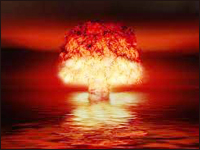
It reminded me of a scene in the movie Oppenheimer in which nuclear scientist Robert Oppenheimer meets with President Harry Truman shortly after the atomic bombs were dropped on Hiroshima and Nagasaki during World War 2.

Following his successful testing of the bomb, Oppenheimer was known to have uttered the words, “Now I am become death, the destroyer of worlds”, a quote from the Bhagavad Gita, a holy scripture from Hinduism.

After Hiroshima and Nagasaki, Oppenheimer told Truman he felt he had “blood on his hands”.

Truman angrily responded with the words, “The blood is on my hands, not yours. It was me who dropped the bomb, not you”.

With that the meeting was over and Truman said he “never wanted to see that man again”.

There’s more than a little Oppenheimer in Albanese’s view of himself and the world around him. Here’s why I think that.

There’s an old Greek proverb, “The fox knows many things, but the hedgehog knows only one thing.”

Albanese knows only one thing – politics. It’s all he’s ever done.

But as we know, the world isn’t made up of just one thing, it is made up of a whole range of competing factors and trade-offs that differ for different people of different ages who live in different places and have different priorities.

Like the ‘crystallised intelligence’ vs ‘fluid intelligence’ paradigm. Crystallised intelligence employs experience and wisdom and knows how the world works. Fluid intelligence knows how to study, learn facts and pass exams. Foxes vs hedgehogs. We’ve all met them.

Harry Truman, a Democrat (a bit like the Labor Party here in Australia), was a very good President. Before entering politics, Truman was a soldier and then a shopkeeper. A better understanding of how the world works you wouldn’t get than by owning a shop! Harry was quite the fox.

But the story is told of when Truman was elected President, his former army buddy and shopkeeper partner, Eddie Jacobson, said to him, “O Harry, now that you’re President, everyone’s going to start telling you what a great man you are, when you and I both know you ain’t”.

Anyone who gets to the top needs an Eddie Jacobson in their lives.

Being knowledgeable on one subject can narrow one’s focus, lead to over-confidence and dismiss dissenting views. This can lead to self-deception, even delusions of grandeur. The Voice perhaps?

The world is a very dangerous place, and it is impossible to predict what will happen next. There are countless variables and factors. Foxes understand this innately, hedgehogs not so much.

For this reason, we have to stop letting the hedgehogs run the show. Let them be advisers, by all means, but do not put them in charge.

They may be fine leading other hedgehogs in a particular field, but the world is not parliament house or a laboratory or a hospital or a courtroom or a classroom or a police station. We can’t let scientists or police commissioners or judges who do not have to answer to the people run the place. Being answerable to the people forces you to understand how the world really works and how to assess the many trade-offs – as the Prime Minister will soon find out.

On a more celebratory note, next month marks the three-year anniversary of the launch of the Australian Family Party – and almost one hundred Newsletters!

Inaugural letterbox flyer from 2020

Our membership is strong and the response to the Newsletters, all of which are listed on our website, has been phenomenal – especially The New Gulag, The MATS Plan Re-visited, Black Hawk Down, Two Stories, One Lesson and of course Remembering Andrew Evans.

But, like the story of ‘the turtle on the fence post’ (if you ever see a turtle sitting on top of a fence post, what is the one thing you know? – It didn’t get there by itself!), if anyone wants to get to the top of the fence post in any field – sport, the arts, business, and yes, politics – you’re not going to get there by yourself. You’re going to need a lot of help from a lot of people.

In our case, that includes other minor parties.

As I outlined in The Shrinking Forest earlier this year, alliances with like-minded parties are essential for success.

More news about that in coming months.

Filed Under: Australian Politics, Australian Character, Culture Wars, Family Policy, Foxes and hedgehogs, Freedom, Launch, MATS Plan, Social policy, South Australia

The New Gulag

17/07/2023 by Australian Family Party

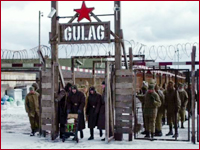
new-gulagIn his famous three-volume masterpiece, The Gulag Archipelago, Aleksandr Solzhenitsyn described the frozen wastelands of Siberia where political prisoners and dissidents the Soviet state considered dangerous were held (for their speech, not their actions). A gulag was a Soviet prison; an archipelago is a string of islands; hence the term ‘gulag archipelago’ – a string of camps, prisons, transit centres, secret police, informers, spies and interrogators across Siberia.

Today, people are frozen out of society in more subtle ways. The authorities no longer bash down your door and haul you off to a gulag for espousing the ‘wrong views’; instead they silence you and freeze you out of existence in other ways.

No-one describes the current situation better than Scottish commentator Neil Oliver in his Essentials of Life video clip. More about that shortly.

Divide and conquer

As we know, the Left’s chief weapon is division. Unite the disaffected groups and those with grievances, and then ‘divide and conquer’ the rest of us. Divide along racial, generational, sexual, religious or economic lines. Any line will do.

What may have started as ‘the workers vs the bosses’ – ‘the proletariat vs the bourgeoisie’ – and ‘supporting the poor’, was just a ruse to gain power. Workers and the poor have long since been abandoned by the Left who now find other ways to divide and conquer.

In his excellent book, Democracy in a Divided Australia, Matthew Lesh writes:

‘Australia has a new political, cultural, and economic elite. The class divides of yesteryear have been replaced by new divisions between Inners and Outers. This divide is ripping apart our political parties, national debate, and social fabric.

Inners are highly educated inner-city progressive cosmopolitans who value change, diversity, and self-actualisation. Inners, despite being a minority, dominate politics on both sides, the bureaucracy, universities, civil society, corporates, and the media. They have created a society ruled by educated elites – that is, ruled by themselves.

Outers are the instinctive traditionalists who value stability, safety, and unity. Outers are politically, culturally, and economically marginalised in today’s graduate-dominated knowledge society era. Their voice is muzzled in public debate, driving disillusionment with the major parties, and record levels of frustration, disengagement, and pessimism.’

For over a hundred years, Australia fought to remove race from civic considerations. Yet now we are being asked to permanently divide the nation by entrenching an Indigenous Voice into our Constitution. By the ‘Inners’, of course.

In the workplace, politicians are still treating workplace behaviour like a game of football. Australia’s employers (‘the bosses’) are on one team, and Australia’s employees (‘the workers’) are on the other. The game is then overseen by a so-called ‘independent umpire’ called the Fair Work Commission. But of course, this is not how workplaces operate at all. The ‘game’, if you even want to call it that, is played not by two teams of employers and employees, but by hundreds, even thousands of different teams, competing against hundreds and thousands of other teams of employers and employees.

Mark Twain observed, “Few things are harder to put up with than the annoyance of a good example”.

Here’s one – the infamous Dollar Sweets dispute where unions were picketing Fred Stauder’s confectionery business. Other confectionery businesses were approached to support Fred but were rebuffed saying, “Why should we care if Dollar Sweets goes down? It will mean more business for us.”  So much for ‘bosses vs workers’.

While paying lip service to free markets, property rights, personal responsibility, self-reliance, free speech, lower taxes, the rule of law, and smaller government, the Liberal Party in Australia has all but abandoned these ideals in practice. As has big business, which, truth be known, was never on the side of free markets. Corporations have always wanted markets they can dominate, and to eliminate the competition. If that means aligning with the Left or doing the government’s bidding, so be it.

Which includes – and here we return to our ‘new gulags’ theme – closing a person’s bank account, destroying them on social media or excluding them from employment. Business is right on board with this.

The Left will keep pushing its woke agenda until it is stopped. And it will not be stopped with facts, figures, logic, evidence or reason. It doesn’t care about any of that. It will only be stopped with political power.

Holding conferences, writing opinion pieces, producing podcasts and YouTube interviews in the hope of persuading people have, I’m afraid, had their day. The ‘Inners’ now rule.

Stopping the relentless march of the Left will require political power. Seats in parliament. Which means like-minded people and parties forming alliances and working strategically and tactically together to win seats.

In Neil Oliver’s video clip, he says, “When it comes to the state, that which it can do, it certainly will do” and “What can happen to anyone, will soon happen to everyone”.

So, if you belong to a think-tank, lobby group or centre-right political party, and want to stop the woke Left further ruining our country, then please encourage your organisation to place less emphasis on winning arguments and more emphasis on winning seats – as previously outlined here and here.

Filed Under: Australia's economic future, Australian Politics, Culture Wars, Family Policy, Freedom, Social policy, Voice to Parliament

Beam Me Up, Scotty

21/06/2023 by Australian Family Party

beam-me-upIt is two years since we launched our ‘Family, Faith & Freedom’ campaign invoking that iconic TV series Star Trek.

Since that time, each of these three foundational principles of Western Civilisation has been relentlessly attacked by three destructive and sinister campaigns – Climate, Race & Gender.

Let’s start with Family.

Have you noticed how many childcare centres have sprung up lately?

As former US President Franklin D. Roosevelt (FDR) used to say, “In politics, nothing happens by accident. If it happens, you can bet it was planned that way.”

If one wanted to indoctrinate the next generation, then getting to the children as early as possible is the key.

Applying the FDR principle, the more children into childcare – or ‘early learning centres’ – the better.

But why so many?

Could it be due to the entirely manufactured housing affordability crisis – or to be more accurate, the entirely manufactured ‘land affordability’ crisis – forcing both parents out to work?

As we have pointed out here before, Australia does not have a ‘housing’ affordability problem, it has a ‘land’ affordability problem. As most people know, over the past 20 years, the cost of building a new house in Australia has roughly kept pace with inflation. Land prices, however, have skyrocketed. By deliberately restricting the amount of land available on the urban fringes of our cities, governments have sent the price of land and thus housing through the roof. It is now virtually impossible to buy a house and service a mortgage on one wage. Hence, both parents out to work and young children into childcare.

And what, dare we ask, are the children being taught in these ‘early learning centres’?

First, there is the international ‘Climate Action Childhood Network’ which states on its website, “We believe a paradigm shift in early childhood education can provide a path to deeper societal changes that are required”.

Then there are the ‘Acknowledgement of Country’ mantras which are taught to children.

And of course, the ‘Rainbow Agenda’.

‘Climate, Race and Gender’, the leitmotifs of the Left sweeping the Western world. The long march through all our state institutions indeed.

Again, an entirely manufactured ‘climate emergency’ is set to destroy our economy. The collapse of the energy grid as a result of the manic shift to so-called ‘renewables’ is all but inevitable.

And ‘Race’ will divide society. For over a hundred years, Australia has fought to remove race from civic considerations. Yet now we are on track to permanently divide the nation by entrenching an Indigenous Voice into our Constitution.

As former Labor Minister and Commissioner for Charities and Not-For-Profits, Gary Johns said recently, “Are Aboriginal people really that different that we need a treaty to talk to each other? Do people who are neighbours and workmates need a treaty to get on? The very thought of heading down such a road would divide Australians and destroy reconciliation”.

And ‘Gender’ will undermine the family, society’s most fundamental building block.

One of the world’s most prestigious universities, Johns Hopkins, has just redefined lesbianism as ‘a non-man being attracted to a non-man’, and Sydney’s Royal Hospital for Women is countenancing the transplanting of wombs into ‘women assigned male at birth’.

LGBTIQA+ literature, an anti-Christian mindset and events such as ‘Gay Pride Month’ also brook no dissent, inflicting immense pressure to participate. There is no ‘opting out’. “Why are you not celebrating with us? Are you homophobic? Or a bigot?” Intimidation is the weapon of choice.

Our ‘Family, Faith & Freedom’ post has stood the test of time. I encourage you to re-visit it.

I would also encourage you to watch this magnificent clip about freedom by Scottish commentator Neil Oliver. It is breathtaking in its truthfulness: Neil Oliver ­– the pursuit of happiness.

Thank you for your support, it is greatly appreciated. Without it we cannot continue our fight for Family, Faith & Freedom. Please support us here.

Filed Under: Australia's economic future, Australian Character, Australian Politics, Culture Wars, Family Policy, Freedom, Housing Affordability, Social policy

  • « Go to Previous Page
  • Page 1
  • Page 2
  • Page 3
  • Page 4
  • Page 5
  • Page 6
  • Interim pages omitted …
  • Page 9
  • Go to Next Page »

Primary Sidebar

  • Facebook
  • Instagram
  • LinkedIn
  • Twitter

Bob Day AO, Federal Director Profile

Bob-Day-AO

Profile is here.

Subscribe to our Mailing list!

* indicates required


Recent Posts

  • State Dogged by Political Circus
  • Seven Voices, One Clear Choice
  • Soccer, Sin and a State Election
  • Aussie Osborne – AUKUS 2026 Part 2
  • Aussie Osborne – AUKUS 2026 Part 1
  • Cult Fiction
  • The State vs the People
  • ‘Quis custodiet ipsos custodes?’
  • Which is Witch in ’26?
  • Christmas 2025
  • Never Again?
  • Bounce Back Better
  • The 44% Alarm Bell
  • Courtroom Guinea Pigs

© 2026 The Australian Family Party
Privacy Policy
Contact Us
Authorised by Bob Day, Australian Family Party, 22 Grenfell Street, Adelaide SA 5000