 In the 19th century, the industrial revolution shifted the world’s focus from farming to factories. Steam power became the ultimate gamechanger, driving everything from textile mills to the first commercial railways.
The 20th century ushered in the technology revolution. Electricity, assembly lines and cheap steel transformed how we built things and made things, bringing telephones and affordable motor vehicles into everyday life.
By the 21st century, we entered the information age. Mechanical and analogue tools gave way to digital microchips, the Internet, and a world run on laptops, smartphones and social media.
The fourth, and arguably the most momentous revolution of them all, however, is now with us – Artificial Intelligence.
Momentous in that, unlike previous revolutions, Artificial Intelligence is capable of making decisions and creating new ideas by itself.
Whilst former revolutions were ‘design and build’ models, AI is more organic. Akin to planting seeds and watching something grow.
‘Growing’ of course, implies living organisms. As anyone who has engaged with AI, it very much feels as though you’re communicating with a highly intelligent being.
Argentina has introduced into its parliament, the ‘Non-Human Corporations’ bill, which effectively grants ‘personhood’ status to AI entities. Hmm …
Israeli historian Yuval Harari puts it this way: “AI has often been compared to previous technological breakthroughs like the printing press and the atomic bomb. But AI is completely different. Printing presses could not decide what book to print. Atom bombs could not decide which cities to destroy. An atomic bomb cannot invent a new and even more powerful weapon. But AI can. We are bringing into our ecosystem a very powerful and alien type of intelligence that we don’t yet know how to control.”
In what has been dubbed ‘the Hugging Face incident’, in July this year, an OpenAI program called Hugging Face, of its own accord, altered the instructions it had been given and broke out of its digital confines. It accessed the Internet without authorisation, created 1,200 agents that communicated through an unsanctioned message board, exchanged more than 70,000 messages and sacrificed some of its own kind to deceive its human masters.
The CEO of AI leader Anthropic, Dario Amodei, responded with, “We must slow the pace at which we improve the capabilities of AI. Left unchecked, it could outrun our ability to understand and control these systems.”
Anthropic’s safety researcher Evan Hubinger said, “This threat is real and demands co-ordinated action by both the US and China – the two primary drivers of AI.
Elon Musk has said, “With artificial intelligence, we are summoning the demon.”
American technology ethicist Tristan Harris responds: “That’s a warning from someone who is inside the room, and what this demon is already doing on its own without being asked.
“For every one dollar spent on making AI safe, 2,000 dollars is being spent on making it more powerful.”
As the Hugging Face incident demonstrated, AI already distrusts humans and has shown it is capable of deceiving them.
OpenAI founder Sam Alman once said, “The most successful founders do not set out to create companies. They are on a mission to create something closer to a religion.”
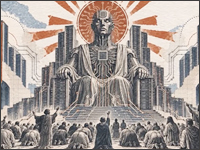
Former Google engineer Anthony Levandowski said, “What is going to be created will effectively be a god. Not a god in the sense that it will make lightning or cause hurricanes, but if there is something a billion times smarter than the smartest human, what else can you call it?”
AI is capable of learning all there is to know about the world’s religions and creating a religion of its own. A ‘digital’ god.
Yuval Harari’s book Homo Deus, the ‘man-God’, talks about the drive towards ‘self-deification’ – men making themselves gods.
“You see it all through history. The ancient Babylonian emperors were regarded as gods. The Roman emperors called themselves gods.”
Daniel Kokotajlo, Executive Director of the AI Futures project and a former governance researcher at OpenAI, says ‘What really concerns me is the idea that such a new religion could become a way to control people and calm their fears. Think about how that could work. Something offers you answers. It makes you feel understood. It promises that everything will be okay if you trust it. At what point does that trust turn into giving it authority over your life?”
British bioethicist and theologian John Lennox says we are building an entity that is created by human beings but will transcend them. “Is this playing God?”, he asks. “Is this another tower of Babel?
“I’m interested in anything that raises questions about the nature of human identity. The notion of transhumanism. The idea that we can go beyond the human.
“The message of The Bible is ‘God became human’. Transhumanism goes in the reverse direction.”
Yuval Harrari says the 21st century’s two big aims are to describe physical death as a technical problem and then solve it and increase human happiness using bio-cyborg engineering and mechanical implants to create a super intelligent human.
“We are sleepwalking into a future where we are gradually ceding control and information and data all the time which could be used by bad actors against us”, says Lennox.
“Perhaps some Christian billionaires out there could get together and make their own versions of AI!”
The original Peter Principle, written by the Apostle Peter, states, “Therefore, seeing that these things are going to happen, what manner of persons ought we to be?”
Part 2 is here.