• Skip to primary navigation
  • Skip to main content
  • Skip to primary sidebar
  • Home
  • About
  • Policies
  • Events
  • Publications
  • Contact
  • Support
  • JOIN

Australian Family Party

Family Matters

  • Family Resilience
  • Family Economics
  • Family Technology
  • Free to Speak
  • Free to Believe
  • Free to Work

Government overreach

AI and the (St) Peter Principle – Part 2

22/09/2026 by Australian Family Party

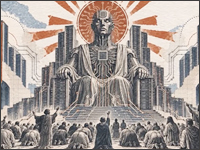
AIIn Part 1 we discussed the evolution of technology from the steam engine through to artificial intelligence and the creation of a digital god.

We closed Part 1 with St Peter’s renowned question, “Therefore, seeing that these things are going to happen, what manner of persons ought we to be?”

Often, a good starting point is to ask what we should not do! Or who we should not turn to.

Unequivocally, the answer to that question is politicians and public sector bureaucrats!

Artificial Intelligence is a veritable gift for politicians and bureaucrats who love nothing more than scaring people into giving them more power – Exhibit A: Covid. Exhibit B: Climate Emergency.

AI ups the ante – ‘It could kill us all in a decade!’

Fear is a powerful political motivator.

Niccolo Machiavelli, the Sixteenth-century archetype of the ruthless political operator, whose name became an adjective for cunning, deceit and the cold calculation of power, saw the political advantages in using fear to control the masses.

As journalist and author Nick Cater puts it, “Pick a threat, make it sound nasty then propose extraordinary government measures to fix it.”

Former Australian politician George Christensen puts it this way, “Never judge a government power according to the politician asking for it now; judge it according to the politician you fear may eventually inherit it.

“New powers should not be judged by the reassuring language wrapped around them, such as ‘protecting children’ or ‘keeping people safe’ or ‘threats to social cohesion’. They should be judged by what they actually allow the state to do and what could happen when those powers are eventually exercised by people who are far less restrained than their authors promised to be.”

In a similar vein, UK Bishop N.T. (Tom) Wright commented: “Do you know what the most frequent command in the Bible is? What instruction is given, again and again, by God, by angels, by Jesus, by prophets and by the apostles? Is it ‘be good’? Is it ‘be holy’? Is it ‘don’t sin’? No, the most frequent command in the Bible is, ‘Don’t be afraid’.”

Over recent years, we’ve seen political issues being increasingly described as ‘misinformation’, ‘disinformation’, ‘malinformation’, ‘extremism’, ‘dangerous’, ‘far-right’, ‘divisive’, ‘hate speech’, and ‘threats to social cohesion’.

Given them the power to control or regulate something as powerful as AI, and politicians and bureaucrats will, without doubt, use it to further their own ends, not yours or mine.

During Covid, former New Zealand Prime Minister, Jacinda Ardern gave us a glimpse of this with her declaration, “We will continue to be your single source of truth. Unless you hear it from us, it is not the truth”.

It is noteworthy that the loudest voices calling for more government oversight hail from the Left – the UK’s Jacob Coxon, the US’s Bernie Sanders, Australia’s David Shoebridge (Greens Party) and Anthony Albanese’s hand-picked member for Parramatta, Andrew Charlton.

“This is starting to look more and more like Marxism for the algorithmic age’, says technology entrepreneur Shyam Sankar.

In 2024, the Albanese Government attempted to introduce the ‘Combatting Misinformation and Disinformation Bill’, making its intentions very clear.

That same year, ‘misinformation and disinformation’ rose to number one on the list of the Top 10 risks cited by the World Economic Forum’s (WEF) Global Risks Report.

If and when the ‘Combatting Misinformation and Disinformation Bill’, is reintroduced and becomes law, all the government has to do is label something ‘misinformation’ or ‘disinformation’ or ‘malinformation’ to have it shut down.

Together with the Government’s latest proposal – the ‘Online Safety Act’ and its ‘Digital Duty of Care’ – the combination of these freedom-sapping pieces of legislation with more AI oversight, will become a mechanism for suppressing legitimate political speech and see personal freedoms deteriorate markedly.

To paraphrase Benjamin Franklin, ‘Those who surrender their freedoms for the promise of safety end up with neither’.

Finally, it was Adam Smith who first articulated the principle of ‘regulatory capture’, warning that merchants and manufacturers constantly attempt to manipulate laws and regulations to serve their own interests at the public’s expense. These days we call them ‘rent-seekers’.

The AI race is no different.

Dario Amodei heads up Anthropic, the current leader in AI development. Anthropic is a ‘closed’ AI model. Amodei is leading the call for government oversight.

‘Open’ AI models such as GPT, however, are not so keen on government intervention.

To summarize what our response to AI might look like:

  1. Stand fast; don’t be afraid.
  2. Treat everything politicians and bureaucrats tell you with the utmost scepticism.
  3. Be wary of industry players who call for more government intervention.
  4. Be wary of (don’t vote for), any politician asking for more power to control AI.
  5. Keep up to date with what is happening in the AI space.
  6. Limit your own digital footprint and the amount of data you share.
  7. Secure all your online accounts.
  8. Defend against AI-driven cyber-threats with strong credentials and unique passwords.
  9. As much as possible, be aware of everything that enters your home and family.
  10. Be more deeply present in your local church and community.

Thank you for your support.
Filed Under: Artificial Intelligence, Australia's economic future, Australian Character, Australian Politics, Christianity, Family Policy, Freedom, Government overreach, Officialdom, Political language, Religious freedom

AI and the (St) Peter Principle – Part 1

21/09/2026 by Australian Family Party

AIIn the 19th century, the industrial revolution shifted the world’s focus from farming to factories. Steam power became the ultimate gamechanger, driving everything from textile mills to the first commercial railways.

The 20th century ushered in the technology revolution. Electricity, assembly lines and cheap steel transformed how we built things and made things, bringing telephones and affordable motor vehicles into everyday life.

By the 21st century, we entered the information age. Mechanical and analogue tools gave way to digital microchips, the Internet, and a world run on laptops, smartphones and social media.

The fourth, and arguably the most momentous revolution of them all, however, is now with us – Artificial Intelligence.

Momentous in that, unlike previous revolutions, Artificial Intelligence is capable of making decisions and creating new ideas by itself.

Whilst former revolutions were ‘design and build’ models, AI is more organic. Akin to planting seeds and watching something grow.

‘Growing’ of course, implies living organisms. As anyone who has engaged with AI, it very much feels as though you’re communicating with a highly intelligent being.

Argentina has introduced into its parliament, the ‘Non-Human Corporations’ bill, which effectively grants ‘personhood’ status to AI entities. Hmm …

Israeli historian Yuval Harari puts it this way: “AI has often been compared to previous technological breakthroughs like the printing press and the atomic bomb. But AI is completely different. Printing presses could not decide what book to print. Atom bombs could not decide which cities to destroy. An atomic bomb cannot invent a new and even more powerful weapon. But AI can. We are bringing into our ecosystem a very powerful and alien type of intelligence that we don’t yet know how to control.”

In what has been dubbed ‘the Hugging Face incident’, in July this year, an OpenAI program called Hugging Face, of its own accord, altered the instructions it had been given and broke out of its digital confines. It accessed the Internet without authorisation, created 1,200 agents that communicated through an unsanctioned message board, exchanged more than 70,000 messages and sacrificed some of its own kind to deceive its human masters.

The CEO of AI leader Anthropic, Dario Amodei, responded with, “We must slow the pace at which we improve the capabilities of AI. Left unchecked, it could outrun our ability to understand and control these systems.”

Anthropic’s safety researcher Evan Hubinger said, “This threat is real and demands co-ordinated action by both the US and China – the two primary drivers of AI.

Elon Musk has said, “With artificial intelligence, we are summoning the demon.”

American technology ethicist Tristan Harris responds: “That’s a warning from someone who is inside the room, and what this demon is already doing on its own without being asked.

“For every one dollar spent on making AI safe, 2,000 dollars is being spent on making it more powerful.”

As the Hugging Face incident demonstrated, AI already distrusts humans and has shown it is capable of deceiving them.

OpenAI founder Sam Alman once said, “The most successful founders do not set out to create companies. They are on a mission to create something closer to a religion.”

Former Google engineer Anthony Levandowski said, “What is going to be created will effectively be a god. Not a god in the sense that it will make lightning or cause hurricanes, but if there is something a billion times smarter than the smartest human, what else can you call it?”

AI is capable of learning all there is to know about the world’s religions and creating a religion of its own. A ‘digital’ god.

Yuval Harari’s book Homo Deus, the ‘man-God’, talks about the drive towards ‘self-deification’ – men making themselves gods.

“You see it all through history. The ancient Babylonian emperors were regarded as gods. The Roman emperors called themselves gods.”

Daniel Kokotajlo, Executive Director of the AI Futures project and a former governance researcher at OpenAI, says ‘What really concerns me is the idea that such a new religion could become a way to control people and calm their fears. Think about how that could work. Something offers you answers. It makes you feel understood. It promises that everything will be okay if you trust it. At what point does that trust turn into giving it authority over your life?”

British bioethicist and theologian John Lennox says we are building an entity that is created by human beings but will transcend them. “Is this playing God?”, he asks. “Is this another tower of Babel?

“I’m interested in anything that raises questions about the nature of human identity. The notion of transhumanism. The idea that we can go beyond the human.

“The message of The Bible is ‘God became human’. Transhumanism goes in the reverse direction.”

Yuval Harrari says the 21st century’s two big aims are to describe physical death as a technical problem and then solve it and increase human happiness using bio-cyborg engineering and mechanical implants to create a super intelligent human.

“We are sleepwalking into a future where we are gradually ceding control and information and data all the time which could be used by bad actors against us”, says Lennox.

“Perhaps some Christian billionaires out there could get together and make their own versions of AI!”

The original Peter Principle, written by the Apostle Peter, states, “Therefore, seeing that these things are going to happen, what manner of persons ought we to be?”

Part 2 is here.

Filed Under: Australian Politics, Artificial Intelligence, Australia's economic future, Christianity, Digital Dark Age, Family Policy, Freedom, Government overreach, Political language, Religious freedom, Social policy

Cult Fiction

09/02/2026 by Australian Family Party

cult-fictionA fourth-year medical student had just finished top of his class at university.

His parents were so proud of him they gave him a holiday in Nepal for a month-long trek to clear his mind and prepare him for his next year’s study.

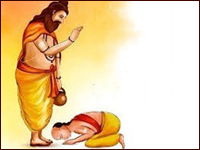
While in Nepal the young man met an Indian guru who told him of the futility of Western society and culture – always striving for success and being dependent on someone else’s failure so you can be successful. “That will never make you happy”, the guru told him. “Give up all this competitiveness and come and live with us in a community where we all love each other and where no-one is trying to take anything away from anyone else.”

The young man had finished five years of private schooling and four years of university and was ripe for this kind of influence.

He rang his parents from Kathmandu and said he was dropping out of medical school and going to live in an Ashram.

You can imagine how pleased they were to hear this.

Six months later they received a letter from their son:

“Dear Mum & Dad
I know you weren’t pleased with me for dropping out of medical school, but I can’t tell you how happy I am. For the first time in my life, I feel good about the way I’m living. I’ve got the poison of competitiveness out of my system. This new way of life is so in harmony with the essence of my inner being that in only six months I’ve become the No 2 disciple in the whole Ashram, and I reckon I’ll be the No 1 disciple by the end of the year.”

Irony and self-awareness were clearly not the lad’s strong suits.

The late Rabbi Sacks wrote, “Those who are naïve about human nature find themselves disappointed again and again.

“Revolutions, protests, and civil wars continually take place because people think that removing a tyrant or having a democratic election will end corruption, create freedom and lead to justice and the rule of law. People are surprised and disappointed however, when that does not happen. All that happens is a change of faces in the corridors of power.”

After the French Revolution, Napoleon was more dictatorial than Louis XVI. After the Russian Revolution, Stalin was far more brutal than the Czar, and after the Cultural Revolution, Chairman Mao was more autocratic and murderous than any of the Emperors of the Chinese dynasties.

Each of these tyrants – Napoleon, Stalin and Mao – as well as fomenting anti-sovereign hatred – also held a deep hostility towards God:

“We will never be free until we strangle the last king with the guts of the last priest”, proclaimed French philosopher Denis Diderot.

Charming.

As with our young man in the Ashram, what the people who support these tyrants naïvely overlook is the inability of human beings to prevent the abuse of power and position once it has been attained.

The threats to Australia – and the Western world – are not climate change or health epidemics or economic instability, they are in the slow takeover of every aspect of our lives by those who seek more and more power over us.

What we are witnessing is the ascension of a new authoritarianism.

“Know everything in order to control everyone,” said Adam Weishaupt.

And technology and mass surveillance will allow governments to do just that – know everything.

The State is accumulating more and more power – all, of course, in the name of ‘fighting crime’ or ‘public health’ or ‘protecting children’ or ‘social cohesion’. Yet it always turns out the same – a compliant and submissive population.

The Commonwealth Parliament, supported by both major parties, has just rammed through the Combatting Antisemitism, Hate and Extremism (Criminal and Migration Laws) Act 2026.

As Liberty Itch’s Steve Holland reports, “The subsequent political fallout for the so-called ‘Liberal’ Party comes as no surprise.

“The Liberal Party is no longer the liberal political movement it once claimed to be. Justifiably, the Nationals aren’t interested in a coalition partner that has abandoned its principles by supporting laws that are completely antithetical to its stated values and platform.

“It is a bitter betrayal by those who claim to safeguard our liberties. While primary blame lies with the Labor Government for concocting such appalling laws, the Liberal Party’s complicity is especially disgraceful given its supposed commitment to free speech and individual freedom. As is often the case, hypocrisy amplifies the backlash.”

In England, zone restrictions have been introduced preventing motorists from driving from one part of town to another.

In Holland, banks are tracking what people spend their money on with a ‘carbon emissions summary’ – from food to airline tickets to petrol – noted on their receipts.

In Australia, smart meters are being used to control people’s power usage remotely.

What you buy, what you say, where you go, how much power you use …

Sig Samuel wrote, “This is religion minus all the God stuff. These atheists are more religious than Christians!”

The State, its gurus and high priests every bit as dogmatic and dictatorial as you’ll find in any sect, cult or Ashram, has become the new religion.

We must stand firm.

Thank you for your support.

Filed Under: Australia's economic future, Australian Character, Australian Politics, Culture Wars, Freedom, Government overreach, Officialdom, Political Itch, Political language, South Australia Election 2026

Primary Sidebar

  • Facebook
  • Instagram
  • LinkedIn
  • Twitter

Bob Day AO, Federal Director Profile

Bob-Day-AO

Profile is here.

Subscribe to our Mailing list!

* indicates required


Recent Posts

  • AI and the (St) Peter Principle – Part 2
  • AI and the (St) Peter Principle – Part 1
  • Army of One
  • Stork in the Road
  • Remembering Al Capone
  • State Dogged by Political Circus
  • Seven Voices, One Clear Choice
  • Soccer, Sin and a State Election
  • Aussie Osborne – AUKUS 2026 Part 2
  • Aussie Osborne – AUKUS 2026 Part 1
  • Cult Fiction
  • The State vs the People
  • ‘Quis custodiet ipsos custodes?’
  • Which is Witch in ’26?

© 2026 The Australian Family Party
Privacy Policy
Contact Us
Authorised by Bob Day, Australian Family Party, 22 Grenfell Street, Adelaide SA 5000