• Skip to primary navigation
  • Skip to main content
  • Skip to primary sidebar
  • Home
  • About
  • Policies
  • Events
  • Publications
  • Contact
  • Support
  • JOIN

Australian Family Party

Family Matters

  • Family Resilience
  • Family Economics
  • Family Technology
  • Free to Speak
  • Free to Believe
  • Free to Work

China

Stork in the Road

15/06/2026 by Australian Family Party

In 1926, Charles Vance Millar, a wealthy Toronto lawyer and lifelong practical joker, died leaving no direct heirs.

In his will, he bequeathed his shares in a racetrack to a number of anti-gambling crusaders; his brewery stock to temperance-preaching ministers; and his holiday house to three people who disliked each other, as joint tenants.

Most famously, however, he left the bulk of his estate to ‘… the woman who bore the most children in Toronto over the next decade!’

That final bequest became known as the ‘Great Stork Derby’.

The derby ended in a tie with four women sharing the prize, each having had nine children.

Millar’s final jest highlighted a timeless truth: when it comes to family formation, incentives matter!

A modern echo of the story came in 2004 when Australia’s Treasurer, Peter Costello, urged couples to have ‘one for mum, one for dad, and one for the country’ – sweetened by a $5,000 baby bonus.

Financial incentives alone, however, have proven to be limited against deeper structural barriers.

Extensive research has shown a clear link between affordable, low-density housing and higher birth rates. When young families can access low-density detached homes on large blocks at reasonable prices, they are more likely to have more children.

No surprises there.

Expensive, multi-storey apartments, on the other hand, delays or deters parenthood.

In this regard, South Australia’s abandonment of the Metropolitan Adelaide Transportation Study (The MATS Plan) in 1970 is an interesting case study.

The MATS Plan was a world-class road network for Adelaide’s future transport needs designed to service a vibrant, emerging city.

Released in November 1968, the plan envisioned an integrated road network supporting a growing city, together with ample, affordable fringe land for detached family homes—the ‘Menzies Dream’, named after Australia’s longest-serving Prime Minister Robert Menzies.

Menzies had presided over a golden age of owner-occupied houses with large gardens and private vehicle access (multiple academic studies and surveys have consistently shown that owning or having reliable access to a motor vehicle substantially improves a person’s chances of finding and keeping a job).

With a median house price just three times the median income, homeownership rates under Menzies reached over 70 per cent.

This conservative view of the world was, however – and continues to be – anathema to the radical Left.

Nurtured in our Universities, the Left’s campaign for dense, inner-suburban apartments and public transport, won over then Labor Premier Don Dunstan and Adelaide’s MATS Plan was ditched.

Its abandonment was, without doubt, South Australia’s biggest ever public policy failure.

As a result of that ill-fated decision, SA has suffered incalculable cost, inefficiency, and 50 years of congestion, due to its inadequate road system.

But a more consequential effect has been the limited access to new land supply resulting in elevated housing costs and suppressed family formation.

This pattern has been repeated across the Western world.

Median house prices in major Anglosphere cities (Australia, Canada, Britain, New Zealand, US) have more than doubled – even tripled in many places – in real terms relative to median incomes.

Young couples now spend a far higher proportion of their income on mortgage repayments, leaving less money available to spend raising children. Many even defer family formation altogether, reasoning they cannot afford both a home and children.

The results mirror the demographic catastrophe of China’s infamous ‘One Child Policy’ but through market distortion rather than government decree. The West has imposed its own version of China’s one child policy via housing unaffordability.

Future taxpayers will now face rising pension and aged-care burdens as smaller cohorts of young workers will be required to support larger retiree populations—precisely the demographic time-bomb China now confronts.

Politicians may have enjoyed the feel-good wealth effect that existing owners had in the early 2000s – as former Prime Minister John Howard famously stated in 2003, “I don’t get people stopping me in the streets and complaining that the value of their house has gone up” – but they now face a backlash.

Reversing this won’t be easy.

Removing urban growth boundaries, making residential use ‘permitted’ on fringe land, eliminating ‘upfront’ utility charges – all services should be paid for ‘as’ homeowners use them, not ‘before’ they use them – and simplifying approvals.

There is also much the Commonwealth Government could do to pressure State Governments namely:

  • Using the Corporations Power to allow any corporation that owns land to have the right to make it available for housing irrespective of any state planning law.
  • Instructing the ACCC to investigate land-price-gouging practices by State government land management agencies.
  • Reducing its grants to States or Territories that were found to have gouged publicly owned land for profit at the expense of housing affordability.

Such steps would start the process of lowering prices towards the historical three-times-income benchmark, enabling young families to buy, settle, and grow.

Charles Millar’s Great Stork Derby was a humorous private incentive.

Public policy, however, should not require such gimmicks.

By prioritizing affordable low-density housing, governments can remove one of the main barriers to the natural desire for children.

South Australia’s MATS Plan abandonment cost generations dearly in congestion, opportunity, road fatalities and births forgone.

Its lessons should not be forgotten.

The Australian Family Party

Where to now for the Party?

As discussed in our post-SA election Newsletter Remembering Al Capone, the political tsunami that was One Nation, swept all before it.

People who would normally have voted for one of the parties on the Right (Liberals, Nationals, Christian parties, Libertarians, etc) all went over to One Nation.

There is no doubt that what One Nation did in South Australia – and then the Farrer by-election – will continue across Australia. Similar results are likely in the Victorian election in November, the NSW election next March, and the Federal election in 2028.

We did all we could to present an alternative on the Right side of politics – as did other minor parties. All succumbed to the One Nation juggernaut.

Thank you once again to everyone who helped with the campaign.

We will now bide our time and maintain our registration, and watch what happens with One Nation. We wish them well.

In the meantime, my long-standing interest in housing and its supporting infrastructure has led me to establish the MATS Plan Institute – the Maritime Adelaide Transport System.

I trust it will be of interest to you.

Thank you again for all your support.

Filed Under: Australia's economic future, Australian Character, Australian Politics, China, Culture Wars, Family Policy, Housing Affordability, MATS Plan, South Australia, South Australia Election 2026

A Few Good Men

20/09/2025 by Australian Family Party

few-good-menIn that classic scene from the movie A Few Good Men, Lieutenant Daniel Kaffee, played by Tom Cruise is defending two Marines accused of murdering a fellow Marine based at Guantanamo Bay.
Kaffee believes the Marines were following a ‘Code Red’ – an illegal order for extrajudicial punishment – issued by Colonel Nathan Jessep, the base commander, played by Jack Nicholson.

Kaffee gets under the skin of Jessep who is a formidable, authoritative figure who sees himself as above reproach.

During a tense exchange, Kaffee asks Colonel Jessep, “Did you order a Code Red?”

The Court Martial Judge quickly interjects with, “You don’t have to answer that question.”

Jessep arrogantly responds, “I’ll answer his question”.

“You want answers?” Jessep sneers.

“I think I’m entitled”, replies Kaffee.

“You want answers?” Jessep shouts.

“I want the truth!” Kaffee shouts back.

Jessep then blurts out his famous line, “YOU CAN’T HANDLE THE TRUTH!”

Kaffee once again demands to know, “DID YOU ORDER A CODE RED!”

Jessep erupts with, “Son, we live in a world that has walls, and those walls have to be guarded by men with guns.

“Who’s gonna do that? You?

“I have a greater responsibility than you can possibly fathom … and my existence, while grotesque and incomprehensible to you, saves lives.

“You don’t want the truth because deep down you want me on that wall, you need me on that wall.

“We use words like honour, code, loyalty. We use these words as the backbone of a life spent defending something.

“You use them as a punchline.

“I have neither the time nor the inclination to explain myself to a man who rises and sleeps under the blanket of the very freedom that I provide and then questions the manner in which I provide it.

“I would rather you just said thank you and went on your way. Otherwise, I suggest you pick up a weapon and stand a post”.

When this movie was released in 1992, Tom Cruise’s character Daniel Kaffee was, as you’d expect, the good guy, and Jack Nicholson, the baddie.

But the Utopian post-World War II, post-Soviet Union, ‘End of History’ world that gave rise to movies like A Few Good Men didn’t last.

The world never was, nor is it now, how we’d like or wish it to be. The cruel truth is that our desire for a just, kind, or ideal world inevitably clashes with the harsh, indifferent, and unpredictable nature of reality.

In 2022, in a military news outlet called Task & Purpose, retired US Marine 3-star General Gregory Newbold expounded on this theme in an attempt to remind the civilian population of what the military is and what it does.

“Many citizens – especially our most senior politicians and military leaders – seem to have developed a form of dementia when it comes to warfare. The result is confusion or denial about the essential ingredients of a competent military force. The condition is exacerbated and enabled when the most senior military leaders who ought to know better defer to the idealistic judgements of those whose credentials are either non-existent or formed entirely by ideology.

Newbold is referring to the Lt Kaffees of the world.

He continues: “The military has two main purposes – to deter our enemies from engaging us in warfare and if that fails, to defeat them in combat. Deterrence is only possible if the opposing force believes it will be defeated. Respect is not good enough; fear and certainty are required.

“The military cannot be a mirror-image of the society it serves. Values that are admirable in civilian society – sensitivity, individuality, compassion, tolerance for the less-capable – are often antithetical to the traits that deter a potential enemy and win wars that must be fought.

“There is only one over-riding standard for military capability – lethality – the ability to kill. And the officeholders who dilute this core truth with civil society’s often appropriate priorities undermine the military’s chances of success. Reduced chances of success mean more casualties which makes defeat more likely.

“Wars must be waged only with stone-cold pragmatism, not idealism. War is a means to an end, and the end is defeat of the enemy and the establishment of a peace, but not just any peace but a peace in your favour.

In an ominous warning of troubling times ahead, The Australian’s Paul Kelly reported recently:

“This week the dictators came together in Beijing – Xi Jinping, flanked by Russian President Vladimir Putin and North Korean leader Kim Jong-un – in a display of authoritarian power rarely matched since World War II.

“The vast military display featured nuclear-capable missiles, undersea vehicles, the latest drones, fighter jets, anti-ship missiles and long-range bombers reinforced by thousands of troops goose-stepping in almost perfect co-ordination.

“China intends to dominate in industrial, military and ideological domains.

“Xi’s message is that China’s military dominance of the Asian region will be irresistible.

“The world has just witnessed the most powerful symbolic display of China’s military aspirations with their intimidating logic for Australia.

“And what did our government have to say?

“Nothing – or nothing of any note.

“We cannot even find the language to address the events transforming the world that pose the most serious challenge for our country and people.”

I have never been anti-China.

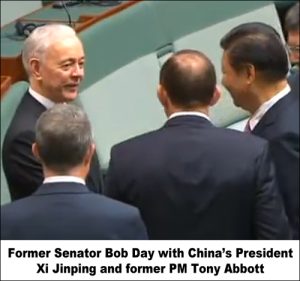
Bob-Day-Xi-AbbottAs reported in my previous comments on China in Beijing to Damascus – A Road to Peace, China has a fascinating Judeo-Christian history.

I have also met Xi Jinping, albeit briefly, in 2014. We talked about housing and how Chinese investors viewed Australia’s property market very favourably.

But a lot that has happened since then disturbs me greatly.

We need options. Our total reliance on the United States is untenable. Its growing internal divisions could seriously impact its external commitments.

One alternative defence bloc could be a Japan–South Korea–Philippines alliance; however, these are all conventional military powers. They would be no match for a nuclear superpower such as China.

India is a friend and is a rising geo-political player. It is also a nuclear power.

But India looks after India, and being an avowed Hindu country, is also culturally very different from Australia.

As Kelly reports, in Beijing, leaders from China, Russia, Iran and North Korea met and did not hide their contempt for the West.

Which brings us once again to Israel.

Israel is currently fighting a war defending Western Civilization.

It is a military superpower.

We should develop a closer relationship.

The Israel-Gaza conflict will soon be over, but China’s military expansion will not.

Can we handle the truth?

Filed Under: Australian Politics, China, Christianity, Defence, Family Policy, Freedom, Israel, Israel-Hamas War, Social policy

Primary Sidebar

  • Facebook
  • Instagram
  • LinkedIn
  • Twitter

Bob Day AO, Federal Director Profile

Bob-Day-AO

Profile is here.

Subscribe to our Mailing list!

* indicates required


Recent Posts

  • Stork in the Road
  • Remembering Al Capone
  • State Dogged by Political Circus
  • Seven Voices, One Clear Choice
  • Soccer, Sin and a State Election
  • Aussie Osborne – AUKUS 2026 Part 2
  • Aussie Osborne – AUKUS 2026 Part 1
  • Cult Fiction
  • The State vs the People
  • ‘Quis custodiet ipsos custodes?’
  • Which is Witch in ’26?
  • Christmas 2025
  • Never Again?
  • Bounce Back Better

© 2026 The Australian Family Party
Privacy Policy
Contact Us
Authorised by Bob Day, Australian Family Party, 22 Grenfell Street, Adelaide SA 5000